Blog
Philippine Public Holidays 2026: AU Compliance Guide

What if a single overlooked date on the calendar could inflate your monthly payroll by 100 per cent overnight? For many Australian firms, managing Philippine public holidays for australian business feels like a constant defensive manoeuvre against unexpected “Double Pay” requirements and operational gaps. You are likely aware that the distinction between “Regular” and “Special Non-working” days is often the difference between a standard shift and a significant budget blowout. This complexity shouldn’t compromise your offshore strategy or leave your local team unsupported during critical AU business hours.
This guide provides the clarity you need to master the 2026 Philippine holiday calendar, ensuring your operations remain compliant, productive, and cost-effective. We will outline the official 2026 schedule, provide a structured framework for calculating holiday pay correctly, and share strategies to maintain seamless business continuity. By the end of this article, you will have a robust plan to shield your business from liability while fostering a reliable, well-managed workforce in the Philippines.
Key Takeaways
- Identify the confirmed 2026 dates for Regular and Special Non-working days to ensure your offshore staffing levels remain sufficient during local closures.
- Master the financial mechanics of philippine public holidays for australian business to avoid unexpected 200 per cent penalty rates and payroll budget blowouts.
- Distinguish between different holiday tiers to mitigate the risk of sham contracting and ensure full adherence to Philippine Department of Labour and Employment (DOLE) standards.
- Establish communication protocols and rostering strategies at least six months in advance to synchronise business continuity between Australian and Philippine calendars.
- Leverage an Employer of Record (EOR) framework to automate complex holiday pay calculations and act as a compliance shield for your international operations.
Navigating the Philippine Holiday Landscape: A Challenge for Australian Operations
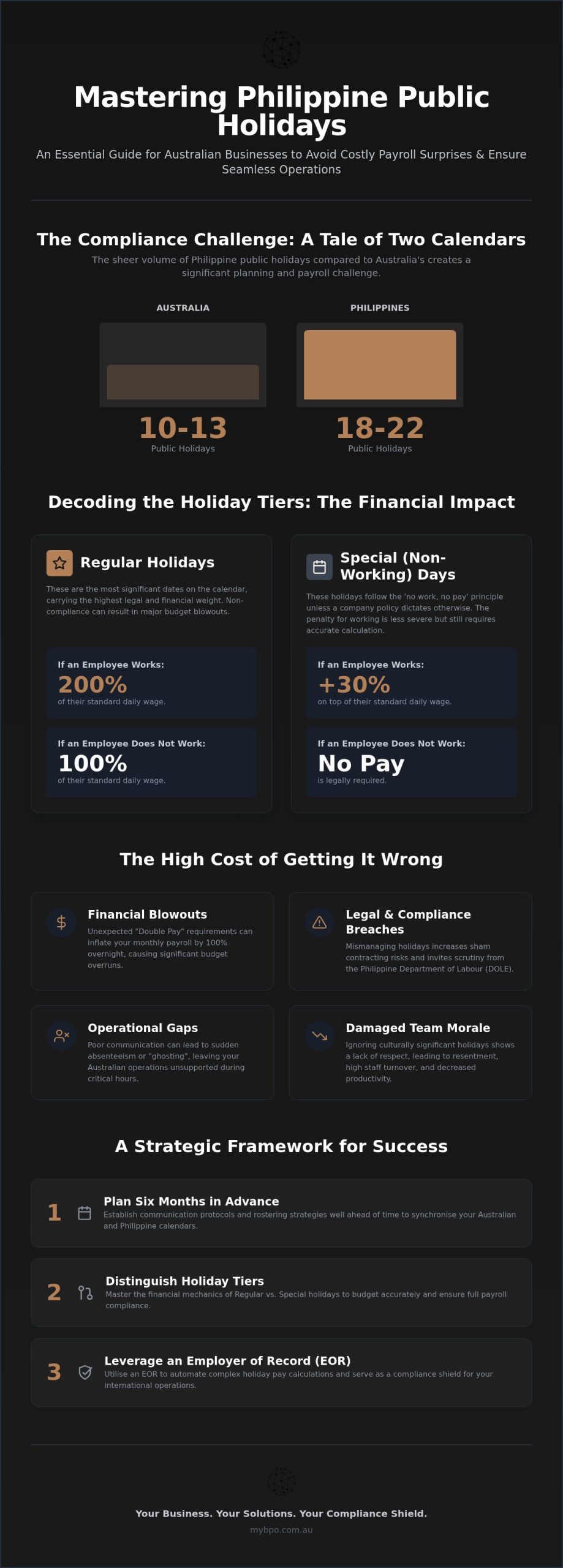
Managing Public holidays in the Philippines requires more than a simple calendar update; it demands a strategic shift in how you view your offshore workforce. Australian businesses often encounter friction when their standard operational hours clash with Philippine statutory rest days. While a typical Australian state observes roughly 10 to 13 holidays, the Philippine calendar is significantly denser, frequently featuring 18 to 22 days of varied significance. Ignoring these dates creates a dangerous compliance gap. Treating offshore staff as though they are exempt from local mandates increases your sham contracting Philippines risk, particularly if you attempt to bypass holiday pay by misclassifying employees as independent contractors.
Beyond the legalities, cultural respect is a primary driver for staff retention and morale. For many Filipino professionals, holidays like Holy Week or All Saints’ Day carry deep religious and familial weight. If an Australian firm fails to acknowledge these periods, the resulting resentment can lead to high turnover and decreased productivity. Effectively managing philippine public holidays for australian business means balancing your need for continuity with the cultural reality of your team’s location.
The Legal Reality of Offshore Employment
Philippine labour law applies to any staff member physically performing work within the Philippines, regardless of where the parent company is headquartered. If your business operates without a local legal entity, you face significant hurdles in meeting these jurisdictional requirements. This is where an Employer of Record (EOR) model becomes essential. An EOR absorbs the legal liability of holiday non-compliance by acting as the official employer on paper. Recent changes in Australian law, such as the Closing Loopholes Act, have intensified the scrutiny on how offshore arrangements are structured. If you don’t secure a compliant framework, you risk falling foul of both Australian misclassification rules and Philippine Department of Labour and Employment (DOLE) standards.
Operational Misalignment Risks
Failing to communicate holiday expectations six months in advance often results in “ghosting” or sudden absenteeism. When staff feel their statutory rights are being ignored, they may choose to take the day off regardless of your roster. This creates critical operational gaps during peak Australian business hours. Underpaying staff on Regular holidays also creates a long-term financial liability. Since Regular holidays require a 200 per cent pay rate for work performed, a “one size fits all” policy that mimics Australian public holiday rates will fail. You must implement a system that recognises the specific tiers of philippine public holidays for australian business to ensure your budget remains predictable and your operations remain secure.
The 2026 Philippine Holiday Calendar: Regular vs Special Non-Working Days
The Philippine government classifies public holidays into two distinct categories, each carrying specific financial and operational mandates. For 2026, these dates are established under Proclamation No. 1006, signed by the President. Understanding this structure is a prerequisite for managing philippine public holidays for australian business, as the distinction determines whether your payroll costs remain stable or double overnight. These holidays also impact the calculation of 13th-month pay, as higher earnings during holiday periods increase the total annual base used for this mandatory year-end bonus. While many dates are fixed, the uncertainty of movable holidays, such as Eidul Fitr and Eidul Adha, requires an agile approach to rostering. These Islamic holidays are finalised only after the National Commission on Muslim Filipinos confirms the lunar sightings closer to the event.
Regular Holidays in 2026
Regular holidays are the most significant dates on the calendar and demand the highest level of compliance. If your staff members work on these days, they are legally entitled to 200 per cent of their daily wage for the first eight hours. If they do not work, they still receive 100 per cent of their salary. The fixed Regular holidays for 2026 include:
- January 1 (Thursday): New Year’s Day
- April 2 (Thursday): Maundy Thursday
- April 3 (Friday): Good Friday
- April 9 (Thursday): Araw ng Kagitingan (Day of Valour)
- May 1 (Friday): Labour Day
- June 12 (Friday): Independence Day
- August 31 (Monday): National Heroes Day
- November 30 (Monday): Bonifacio Day
- December 25 (Friday): Christmas Day
- December 30 (Wednesday): Rizal Day
Operationally, most Philippine businesses close on these dates. If your Australian operations require staff to be present, you must budget for the “Double Pay” rule and ensure your team is willing to forgo traditional family observances, particularly during Holy Week in April.
Special Non-Working Days in 2026
Special Non-working days follow the “no work, no pay” principle. If an employee does not work, they are not entitled to payment unless a specific company policy dictates otherwise. However, if they do work, you must pay an additional 30 per cent premium on top of their basic daily wage. The 2026 schedule includes:
- February 17 (Tuesday): Chinese New Year
- April 4 (Saturday): Black Saturday
- August 21 (Friday): Ninoy Aquino Day
- November 1 (Sunday): All Saints’ Day
- November 2 (Monday): All Souls’ Day
- December 8 (Tuesday): Feast of the Immaculate Conception of Mary
- December 24 (Thursday): Christmas Eve
- December 31 (Thursday): Last Day of the Year
These days offer more flexibility for Australian firms. You can choose to maintain standard operations with a smaller 30 per cent premium, provided you communicate these expectations early. Mastering these tiers is essential for long-term stability. If you find the manual tracking of these shifting dates and varied pay rates complex, our Employer of Record services can act as a safeguard, automating these calculations to ensure total accuracy.
Calculating the Cost: Payroll Compliance and Penalty Rates
Managing payroll in the Philippines for Australian companies requires more than a standard spreadsheet; it demands a rigorous application of statutory multipliers. If you miscalculate these rates, you risk significant back-pay liabilities and potential legal friction with the Department of Labour and Employment (DOLE). The financial framework for philippine public holidays for australian business is built on specific percentages that must be applied to the base daily wage. These calculations are not optional. They are the legal floor upon which your offshore operations must be built to remain secure.
The “Double Pay” Rule and Its Impact
Regular holidays are the most significant cost drivers in an offshore budget. When a team member works on a Regular holiday, they must receive 200 per cent of their daily wage for the first eight hours. If the holiday falls on their scheduled rest day and they are required to work, this rate climbs to 260 per cent. You must also account for the “Day Before” rule. An employee is only entitled to 100 per cent pay for a Regular holiday they did not work if they were present or on paid leave on the workday immediately preceding the holiday. For 2026, April and December are peak payroll months due to the high density of Regular holidays. You must budget for these spikes well in advance to avoid cash flow disruptions.
Special Non-Working Day Financials
Special Non-working days operate under the “no work, no pay” principle, providing a degree of budgetary flexibility. If an employee does not work, you have no legal obligation to pay them unless your internal policy states otherwise. However, if they do work, they are entitled to an additional 30 per cent premium, bringing their total pay to 130 per cent of their daily wage. If this work occurs on their scheduled rest day, the premium increases to 50 per cent. Common errors often occur when calculating tax and social contributions on these premiums. You must ensure that holiday pay is correctly integrated into the “gross income” for PhilHealth and SSS calculations to avoid compliance breaches. Mastering these mechanics is the only way to secure your 2026 operations against unexpected financial volatility.
Strategic Planning: Managing Business Continuity Across Borders
Managing a cross-border workforce requires synchronising two distinct legal and cultural calendars. If you fail to plan for the overlap, your Australian service levels will likely suffer. You must establish communication protocols at least six months in advance to set clear expectations for the 2026 calendar year. This foresight allows you to organise skeleton crews that maintain essential functions while respecting the statutory rest days of your Philippine team. Effectively managing philippine public holidays for australian business involves more than just payroll; it’s about protecting your operational momentum against predictable disruptions.
Synchronising the Calendars
The friction between Australian state-based holidays and Philippine national holidays is a constant challenge for offshore managers. For instance, when Australia observes the King’s Birthday in June, your Philippine staff are usually working a standard day. Conversely, Rizal Day on 30 December is a Regular holiday in the Philippines while it remains a normal business day in Australia. You might consider “swapping” days, where staff work a Philippine holiday in exchange for an Australian one. However, you must navigate the legal limitations carefully. Under Philippine law, a Regular holiday cannot be simply “swapped” to avoid the 200 per cent pay rate. The statutory premium remains a mandatory liability if work is performed on that date, regardless of any reciprocal time off provided later.
Maintaining Operational Momentum
High-quality physical infrastructure is the backbone of continuity during regional shutdowns. Ensuring your team has dedicated workspace Philippines access is vital. Residential areas often experience power or internet instability during peak holiday periods when local networks are congested. You should also implement automated responses and client notifications to manage expectations during these gaps. Data security and equipment uptime must be secured through on-site technical support that remains active even when the broader workforce is reduced. This physical presence acts as a safeguard, ensuring that your offshore hub remains a reliable extension of your Australian office. If you need a partner to manage these complex rosters and secure your physical infrastructure, contact MyBPO today to discuss our EOR and workspace solutions.
Mitigating Compliance Risk with MyBPO’s EOR Framework
MyBPO’s Employer of Record (EOR) framework is engineered to absorb the legal and operational risks inherent in cross-border employment. We act as a vigilant compliance shield, ensuring that every nuance of the 2026 holiday calendar is integrated into your strategy without creating an administrative burden for your Australian headquarters. Our automated payroll systems are specifically configured to handle the “Double Pay” rules and Special Non-working day premiums discussed in previous sections. This removes the danger of manual error and ensures that your budget for philippine public holidays for australian business remains accurate and predictable. By maintaining a physical presence in Manila and Bacolod, we provide on-the-ground support that abstract digital platforms cannot match, allowing us to manage staff attendance and sentiment during high-pressure holiday periods.
The MyBPO Advantage
Choosing an Australian-owned and operated EOR provides a layer of security that is vital for firms navigating unfamiliar regulatory waters. You gain direct access to Philippine labour law expertise, which is essential for interpreting shifting proclamations and movable religious dates. We eliminate the weight of local tax compliance, as well as mandatory SSS, PhilHealth, and Pag-IBIG contributions. This structural integrity allows you to focus on growth while we secure the foundational elements of your workforce. Our framework ensures that offshore recruitment Philippines is not just about finding talent; it’s about maintaining a compliant and motivated team for the long term.
Securing Your 2026 Growth
A high-performance team is built on a foundation of mutual respect and legal certainty. If your current offshore setup lacks a robust compliance shield, you are exposed to liabilities that could jeopardise your expansion. We help you build a workforce that respects both Australian operational needs and Philippine cultural traditions, creating a “safe harbour” for your business. This balanced approach is the key to sustainable productivity in the AU-PH corridor. If you are unsure about your current level of protection, we recommend a thorough review of your payroll and employment contracts. Contact MyBPO today to secure your offshore operations and request a compliance audit for your 2026 planning. We take on the burden of risk so you can experience true operational freedom.
Securing Your Operational Future in the AU-PH Corridor
Mastering the 2026 calendar is not merely an administrative task; it’s a strategic necessity for any firm leveraging offshore talent. You now have the framework to distinguish between Regular and Special Non-working days, ensuring your payroll remains accurate while respecting local statutory rights. By implementing proactive communication and securing high-quality physical infrastructure, you eliminate the friction that often disrupts cross-border synchronisation. Effectively managing philippine public holidays for australian business requires a partner that understands the high stakes of international compliance and the nuances of the local landscape.
As an Australian-owned specialist with a physical presence in Manila and Bacolod, MyBPO provides a 100% compliance guarantee. We act as your on-the-ground guardian, absorbing the complexities of local labour codes and automated penalty rate calculations so you can focus on scale. Taking these steps today protects your budget from unexpected blowouts and fosters a loyal, well-supported team. Secure your offshore compliance with MyBPO’s EOR services and ensure your 2026 operations remain stable, predictable, and fully protected. Your path to a seamless international expansion starts with a robust compliance shield.
Frequently Asked Questions
Do I have to pay my Philippine staff for Australian public holidays?
No legal obligation exists under Philippine law to observe Australian holidays. Your team follows the Philippine calendar. If you require them to take an Australian holiday off, you must decide if this is paid or unpaid leave. Many firms choose to offer these as additional benefits to align schedules, but failing to pay for philippine public holidays for australian business remains the primary compliance risk you must manage.
What is the “Double Pay” rule for Philippine Regular holidays in 2026?
The “Double Pay” rule applies exclusively to Regular holidays. If an employee works, they receive 200 per cent of their daily wage for the first eight hours. If they do not work, they are still entitled to 100 per cent of their salary, provided they worked the day before the holiday. This is a non-negotiable statutory requirement. Failure to apply this multiplier correctly can lead to significant payroll audits and financial penalties.
Can I ask my Philippine team to work on a Special Non-working day?
You can request that staff work on Special Non-working days, but you must pay a 30 per cent premium. This brings their total pay to 130 per cent of their daily wage. Unlike Regular holidays, the “no work, no pay” principle applies if the employee does not work. This provides Australian businesses with operational flexibility, allowing you to maintain service levels at a lower cost than the 200 per cent rate required for Regular holidays.
How does 13th-month pay interact with public holidays?
13th-month pay is calculated based on the total basic salary earned during the calendar year. While holiday premiums, the extra 100 per cent for Regular or 30 per cent for Special days, are generally excluded from this calculation, the base pay received for Regular holidays is included. Correctly categorising these payments is essential. Mismanagement of these figures can result in an underpayment of the 13th-month bonus, which is a common trigger for labour disputes.
What happens if a Philippine holiday falls on a Saturday or Sunday?
If a holiday falls on a weekend, it is observed on that specific date unless a presidential proclamation moves the observance. For staff whose rest days fall on these weekends, specific rates apply if they are required to work. A Regular holiday on a rest day attracts a 260 per cent rate, while a Special Non-working day on a rest day requires 150 per cent. You must track these overlaps to ensure your 2026 budget accounts for these higher multipliers.
Is the King’s Birthday holiday recognised in the Philippines?
The King’s Birthday is not a recognised holiday in the Philippines. Your offshore team is expected to work a standard shift unless you explicitly grant them the day off as a company benefit. Managing philippine public holidays for australian business requires a clear understanding that local staff observe their own national and religious dates. Synchronising these disparate calendars is a core component of maintaining business continuity across the AU-PH corridor.
How do I calculate pay if a staff member works on their rest day which is also a holiday?
When a holiday coincides with a scheduled rest day, the pay rate increases to reflect the loss of rest. For a Regular holiday, the rate is 260 per cent of the daily wage. For a Special Non-working day, the rate is 150 per cent. These calculations must be precise. Using an EOR service ensures these complex multipliers are applied automatically, protecting your business from the risk of underpayment and subsequent legal action from the Department of Labour and Employment.
What are the penalties for miscalculating holiday pay in the Philippines?
Miscalculating holiday pay exposes your business to back-pay claims, interest charges, and mandatory DOLE inspections. Beyond the financial cost, repeated compliance failures can damage your reputation as an employer and lead to high staff turnover. In severe cases, it may even trigger a review of your corporate structure. Utilising a specialist EOR provides a compliance shield, ensuring all statutory rates are met and your offshore operations remain legally secure.
Need a strategy session?
Tell us about your team and we will map out the right structure, fixed-cost quote included.
Book a call