Blog
Offshore Recruitment Philippines: The 2026 Buying Guide for Australian Firms

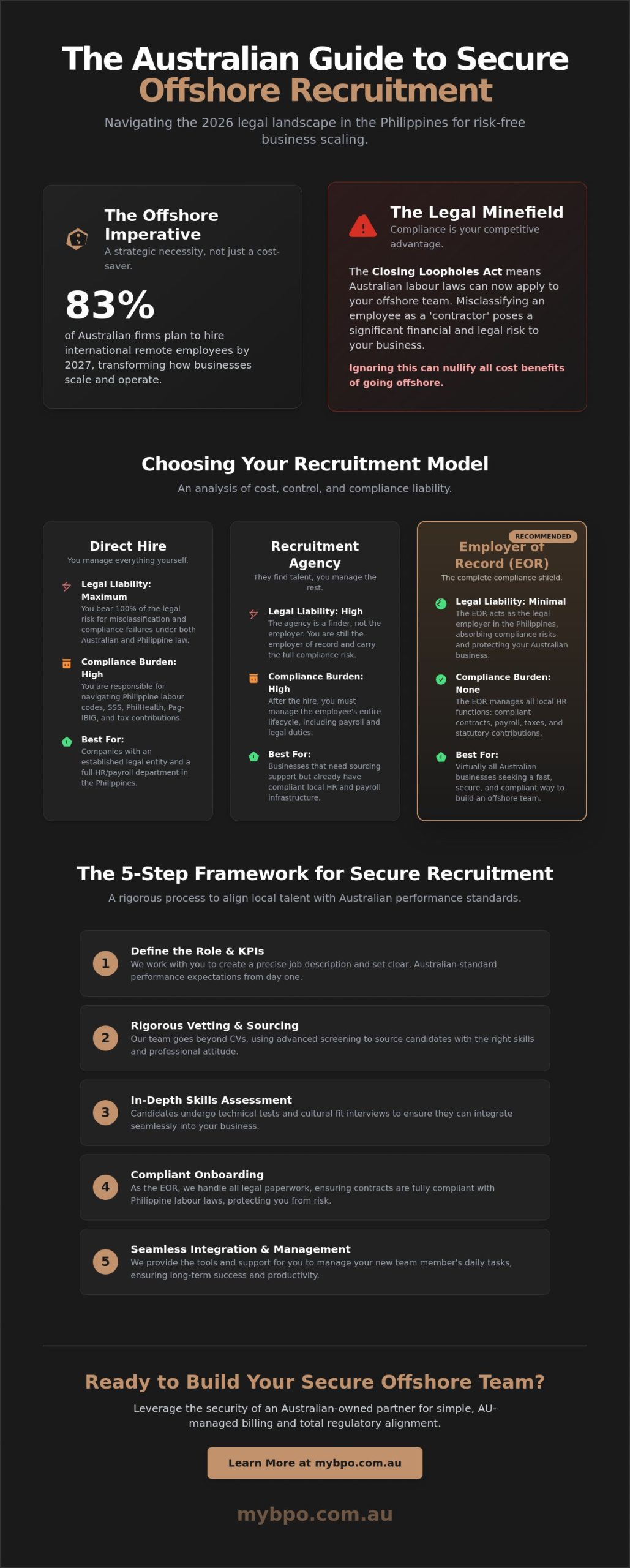
Did you know that 83% of Australian firms plan to hire international remote employees by 2027, yet many remain unaware that Australian labour laws can now follow their offshore workers across borders? Following landmark Fair Work Commission rulings, the legal boundary between a contractor and an employee has never been more scrutinised. You likely recognise that offshore recruitment Philippines is the most viable path to scaling your operations, but the fear of sham contracting penalties or inconsistent talent quality often stalls the process. It’s a valid concern; a single compliance oversight in 2026 can nullify the cost benefits of going offshore.
This guide provides the definitive framework for navigating these complexities, ensuring your business remains protected under both Australian and Philippine jurisdictions. We will break down the latest 2026 regulatory shifts, including the updated 15% SSS contribution rates and the essential role of an Employer of Record (EOR) in securing your legal perimeter. By the end of this article, you’ll understand how to build a high-performing team with the security of Australian-managed billing and total regulatory alignment.
Key Takeaways
- Identify the critical regulatory shifts in the Closing Loopholes Act to protect your Australian business from the severe risks of worker misclassification.
- Evaluate the cost and liability differences between direct hire models and Employer of Record (EOR) services to find your optimal safe harbour.
- Implement a rigorous five-step framework for offshore recruitment Philippines that aligns local talent with Australian-standard performance expectations.
- Transition from fragmented task-based outsourcing to a dedicated, full-time team structure that ensures long-term operational integrity and talent consistency.
- Leverage the security of an Australian-owned partner to navigate foreign labour codes while maintaining simple, AU-managed billing and clear accountability.
The Evolution of Offshore Recruitment in the Philippines for 2026
In 2026, the definition of offshore recruitment Philippines has transitioned from a cost-saving exercise to a core strategic necessity. Australian firms no longer view the region as a repository for low-level tasks. Instead, they see it as a source of high-tier talent capable of sustaining long-term growth. This shift is driven by the realisation that “cheap” labour often results in expensive legal or operational failures. A managed recruitment strategy now prioritises structural integrity over mere headcount.
The days of fragmented, task-based freelancing are ending. Australian business owners have discovered that relying on disconnected contractors creates significant vulnerabilities, particularly regarding data security and intellectual property protection. Dedicated, full-time offshore teams provide the consistency required for complex workflows. Unlike simple job boards that leave the burden of vetting and compliance on the employer, a professional recruitment framework ensures every hire is fit for purpose and legally secured.
To navigate this transition effectively, many business owners partner with a specialised recruitment agency like Amplify Yourself, LLC. They focus on identifying and vetting skilled virtual assistants, ensuring that the talent you bring on board is capable of meeting high professional standards from day one.
Why the Philippines Remains the Top Choice for Australians
The enduring success of Business process outsourcing in the Philippines provides a foundation of stability that other regions lack. For Australian firms, the cultural alignment is a decisive factor. Filipinos possess a high level of English proficiency and a service-oriented mindset that mirrors Australian professional standards. Additionally, the time zone overlap with major centres like Sydney, Melbourne, and Brisbane allows for real-time collaboration. This synchronicity minimises the friction often associated with international remote work.
The Shift Toward Specialised Professional Roles
We are seeing a rapid expansion into specialised fields such as accounting, engineering, and digital marketing. Basic administrative support is now the baseline, not the goal. In 2026, the demand is for “Australian-standard” output, which requires a sophisticated approach to offshore recruitment Philippines. If a candidate cannot navigate the specific nuances of the Australian regulatory environment or industry software, they are a liability. Vetting must be rigorous. It involves more than just checking a CV; it requires a deep understanding of how a Philippine professional will integrate into an Australian corporate culture while maintaining total compliance. For firms specifically looking to scale with remote support staff, understanding how to compliantly engage a virtual assistant Philippines under the 2026 regulatory framework is an essential starting point.
Navigating the Legal Minefield: Compliance as a Competitive Advantage
Legal risk is the primary barrier to successful offshore recruitment Philippines. In 2026, the Australian government has significantly tightened the definition of employment through the Closing Loopholes Act. This legislation dictates that if the substance of a working relationship resembles employment, it will be treated as such by the Fair Work Commission, regardless of the labels used in a contract. For Australian directors, this shift converts a remote staffing strategy into a potential liability if not managed with precision.
The strength of Australia-Philippines trade relations has fostered a mature BPO sector, but it has also increased the visibility of cross-border employment arrangements. Regulatory bodies are no longer ignoring offshore structures. They are actively looking for “sham contracting” where firms avoid paying local entitlements by misclassifying staff as independent contractors. Establishing a “compliance shield” is therefore not just a safety measure; it is a competitive advantage that ensures your business continuity.
The Danger of Misclassification and Sham Contracting
The legal distinction between an independent contractor and an employee rests on the level of control and integration within your business. If you dictate working hours, provide equipment, and manage daily tasks, the worker is likely an employee under Australian law. The Fair Work Ombudsman can impose substantial penalties for misclassification, even for workers located overseas. An Employer of Record (EOR) absorbs these specific liabilities by acting as the legal employer in the Philippines, providing a robust buffer for your Australian entity.
Philippine Statutory Requirements: SSS, PhilHealth, and Pag-IBIG
Navigating the local labour code requires more than just a payroll platform. In 2026, the Social Security System (SSS) contribution rate is 15%, with the employer responsible for 10% and the employee for 5%. You must also account for PhilHealth and Pag-IBIG Fund contributions. A critical trap for the unwary is the “13th Month Pay.” This is a mandatory statutory bonus equivalent to one month’s salary, which must be paid to all rank-and-file employees before December 24th. Failing to budget for this is a common error that damages talent retention and legal standing. For a granular breakdown of these costs, refer to our 2026 compliance guide.
Managing these variables manually is a high-stakes gamble for any Australian firm. Understanding how payroll Philippines for Australian companies intersects with both SSS, PhilHealth, and Pag-IBIG obligations is essential before committing to any offshore staffing model. It is often more prudent to secure your operations through a partner that understands the intersection of both legal jurisdictions.
Evaluating Recruitment Models: Agency vs. EOR vs. Direct Hire
Choosing the right structural model is the most important decision you’ll make in offshore recruitment Philippines. While many Australian businesses are tempted by the perceived cost savings of a direct hire, this path is fraught with structural vulnerabilities. Without a local legal entity, your business cannot easily enforce non-disclosure agreements or protect intellectual property. If a dispute occurs, you have no jurisdictional standing in a Philippine court. This leaves your data and your reputation exposed to risks that an Australian court cannot easily mitigate.
A traditional recruitment agency might find you talent, but they often step away once the contract is signed. This leaves you to navigate the complexities of international payroll and local tax compliance alone. In contrast, the Employer of Record (EOR) model provides a secure middle ground. It allows you to manage the daily output of your staff while a local partner assumes the legal and administrative burdens. This ensures that the cost of your team remains predictable while your risk profile is significantly reduced.
The Employer of Record (EOR) Advantage
An EOR serves as the legal employer on the ground in Manila or Bacolod. They handle the registration, payroll, and statutory benefits discussed previously, while you maintain full operational control over your team’s workflow. This arrangement effectively creates a legal firewall between your Australian entity and the offshore jurisdiction. By using an EOR Australia guide, you can ensure that your expansion is built on a foundation of total compliance rather than temporary convenience.
Traditional BPO vs. Dedicated Virtual Assistants
The 2026 market has moved away from transactional, project-based BPO services. These models often result in high staff turnover and inconsistent quality because the workers are not integrated into your company culture. Building a team with a dedicated virtual assistant offers a superior return on investment. These professionals function as a true extension of your local office. They learn your specific systems and values, which leads to higher output and long-term loyalty. This dedicated approach is the gold standard for offshore recruitment Philippines, as it balances the need for high-performance talent with the necessity of secure, Australian-managed oversight. To understand the full compliance obligations that apply when engaging this type of remote professional, the 2026 compliance and strategy guide for hiring a virtual assistant Philippines provides a comprehensive breakdown of the legal and operational requirements. For Australian firms seeking to move beyond marketplace platforms and establish a secure, structured engagement, the dedicated virtual assistant Philippines secure hiring guide outlines the specific protocols required to satisfy both the ATO and Fair Work Commission in 2026.
The 5-Step Framework for Secure Offshore Recruitment
A successful transition to a remote team requires a methodical approach that prioritises structural integrity over speed. Many firms treat offshore recruitment Philippines as a simple search-and-hire exercise; however, this oversight often leads to high turnover and operational friction. A secure framework begins with a definitive role description that aligns with Australian industry standards. If the expectations are not clearly articulated in a local context, the recruitment process will inevitably fail to attract the right calibre of professional.
Securing the legal perimeter is the second essential step. You must establish a robust Employer of Record (EOR) framework before any contracts are signed. This ensures that your business is protected from jurisdictional disputes and that all local statutory obligations are met from day one. Once the legal foundation is laid, sourcing should be conducted by local experts who understand the nuances of the Philippine labour market. While AI tools can filter resumes, they cannot gauge the cultural alignment or the long-term reliability of a candidate.
Vetting for Quality and Cultural Fit
Interviews must go beyond technical skills to assess how well a candidate integrates with Australian business values. This involves evaluating communication styles and the ability to work within the specific time zones of your Australian office. Technical testing should be conducted in a controlled environment to ensure the results are authentic and reflect “Australian-standard” output. It’s also vital to verify that the candidate has a suitable environment for professional work, as domestic distractions can quickly erode productivity and output quality. Directors who have already navigated the landmark Pascua v Doessel Group ruling understand that engaging a dedicated virtual assistant Philippines through a structured compliance framework is now essential to avoiding reclassification risk under the Closing Loopholes Act.
Infrastructure: Beyond the Home Office
Relying on a home office setup introduces significant risks to data security and operational uptime. Frequent power outages and inconsistent internet connectivity in residential areas can disrupt critical workflows. Securing a dedicated workspace in the Philippines provides a controlled environment with redundant power and enterprise-grade security. This infrastructure is a necessary investment for firms handling sensitive client data or requiring high levels of availability. It moves your operation from a makeshift remote setup to a professionalised business unit.
Equipment leasing ensures your team has the specific tools required to meet your performance benchmarks. Providing standardised hardware allows for better technical support and ensures that your security protocols are strictly followed across the board. Implementing a compliance-first onboarding process completes the framework, ensuring that every new hire understands their legal obligations and your company’s operational standards from their first hour on the job. To begin building your secure team, enquire about our recruitment services today.
Why an Australian-Owned Partner is Your Best Compliance Shield
The final and most critical component of a secure offshore recruitment Philippines strategy is the choice of partner. While many providers operate solely within the Philippines, this creates a jurisdictional gap that leaves Australian directors exposed. If a dispute arises or a compliance failure occurs, a foreign entity offers little recourse under Australian law. An Australian-owned and managed partner acts as a vital bridge, ensuring that your offshore operations are governed by the same professional standards and legal accountability you expect at home.
MyBPO functions as a vigilant guardian of your business interests. We bridge the geographical and cultural gap between Brisbane, Manila, and Bacolod by maintaining a physical presence in both countries. This dual-rooted structure allows us to absorb the complexities of local labour codes while providing you with the transparency of a local alliance. We don’t just facilitate a transaction; we secure your entire operational lifecycle, allowing you to focus on growth without the constant burden of regulatory anxiety.
Local Accountability, Global Reach
Dealing with an Australian entity means you are protected by Australian corporate standards and consumer protections. This local accountability is invaluable when managing high-stakes issues such as data breaches or contract disputes. We simplify your financial operations by providing billing in Australian Dollars (AUD). This removes the volatility of foreign exchange rates and eliminates the administrative headache of managing international bank transfers. Having a local point of contact in your own time zone ensures that urgent matters are resolved with the gravity they deserve, rather than being lost in a cross-border communication void.
The MyBPO Difference: Security and Operational Excellence
Our commitment to your business extends far beyond the initial hire. We manage the entire lifecycle of your team, from the initial offshore recruitment Philippines phase through to ongoing payroll, benefits administration, and performance management. This end-to-end oversight is designed to protect your intellectual property and maintain the integrity of your data. We implement rigorous security protocols that match Australian requirements, ensuring your offshore unit remains a “safe harbour” for sensitive information. If you are ready to scale your business with the protection of a seasoned expert, it’s time to organise a consultation with our experts and secure your offshore future.
Securing Your Business Future Through Strategic Offshore Integration
Scaling your business with high-calibre talent in 2026 requires more than a simple job listing. It demands a sophisticated understanding of the shifting legal landscape, particularly regarding the Closing Loopholes Act and Philippine statutory requirements. By prioritising a dedicated team structure over transactional outsourcing, you ensure long-term operational integrity and consistent output quality. The most effective way to mitigate risk is to partner with a specialist who understands the intersection of Fair Work and DOLE compliance.
MyBPO provides the structural security your firm needs to thrive. As an Australian-owned and operated partner with physical representation in both Australia and the Philippines, we act as your compliance shield on the ground. We absorb the complexities of local labour laws and payroll, allowing you to manage your team with total peace of mind. If you’re ready to evolve your strategy for offshore recruitment Philippines, we’re here to facilitate a seamless transition.
Secure your offshore expansion with MyBPO EOR services and build the high-performing team your business deserves.
Frequently Asked Questions
Is offshore recruitment in the Philippines legal for Australian companies?
Yes, it is legal, provided you comply with both Australian and Philippine labour laws. The risk lies in misclassification. If you treat a worker as an employee but pay them as a contractor, you face penalties. Using a structured framework ensures you stay within the legal boundaries of both jurisdictions. It’s about building a bridge between two legal systems while maintaining total transparency and accountability.
What is the difference between a recruitment agency and an Employer of Record (EOR)?
A recruitment agency simply sources candidates for a one-off fee, whereas an EOR acts as the legal employer of your staff. While the agency exits after the hire, the EOR manages payroll, tax, and local compliance on an ongoing basis. This model absorbs the legal risks that a standard agency cannot mitigate. It provides a long-term solution rather than a transactional service for your firm.
How does the Fair Work Act apply to my staff in the Philippines?
Recent rulings indicate that the Fair Work Act can apply if the relationship resembles employment and has a sufficient connection to Australia. If your staff are integrated into your business operations, the Fair Work Commission may scrutinise the arrangement for sham contracting. A robust EOR structure helps navigate these jurisdictional complexities. It ensures that your Australian entity isn’t inadvertently breaching domestic employment standards through poor classification.
What are the mandatory benefits I must pay for staff in the Philippines?
You are legally required to contribute to the Social Security System (SSS), PhilHealth, and the Pag-IBIG Fund. In 2026, the SSS contribution rate is 15%. You must also factor in the mandatory 13th-month pay and local public holidays. Failing to provide these statutory benefits can lead to severe legal repercussions from the Department of Labor and Employment (DOLE). These costs must be factored into your initial budget.
How do I protect my intellectual property when hiring offshore?
Protection is achieved through enforceable contracts that specify Australian or Philippine jurisdiction and the use of secure infrastructure. Without a local legal entity or EOR, enforcing an NDA in the Philippines is extremely difficult. Utilising dedicated workspaces and equipment leasing also ensures that your data remains within a controlled, secure environment. This physical presence creates a barrier against data leaks that a home office cannot provide.
Do I need to set up a local entity in the Philippines to hire staff?
No, you don’t need to establish a local entity if you utilise an Employer of Record (EOR). Setting up a foreign corporation is a complex and costly process requiring significant capital and local directors. An EOR allows you to engage in offshore recruitment Philippines immediately by using their existing legal structure to employ your team. It removes the administrative burden while maintaining full legal compliance for your business.
What is the 13th month pay, and is it compulsory?
The 13th-month pay is a mandatory statutory bonus equivalent to one-twelfth of an employee’s basic annual salary. It must be paid to all rank-and-file employees by December 24th each year. This is not a discretionary performance bonus; it is a legal requirement under Philippine law that applies to all employees who have worked for at least one month. It’s a non-negotiable part of the local employment code that you must respect.
How can I ensure my offshore staff have a secure and stable internet connection?
The most reliable method is to move staff from home offices into a dedicated workspace with redundant internet lines and back-up power. Residential connections in the Philippines are often prone to outages. By providing a professional office environment, you secure the uptime and data security necessary for high-stakes offshore recruitment Philippines. This approach mitigates the risk of operational downtime that can stall your Australian business and impact your bottom line.
Need a strategy session?
Tell us about your team and we will map out the right structure, fixed-cost quote included.
Book a call