Blog
Hiring an Offshore Data Entry Specialist: The 2026 Australian Buying Guide

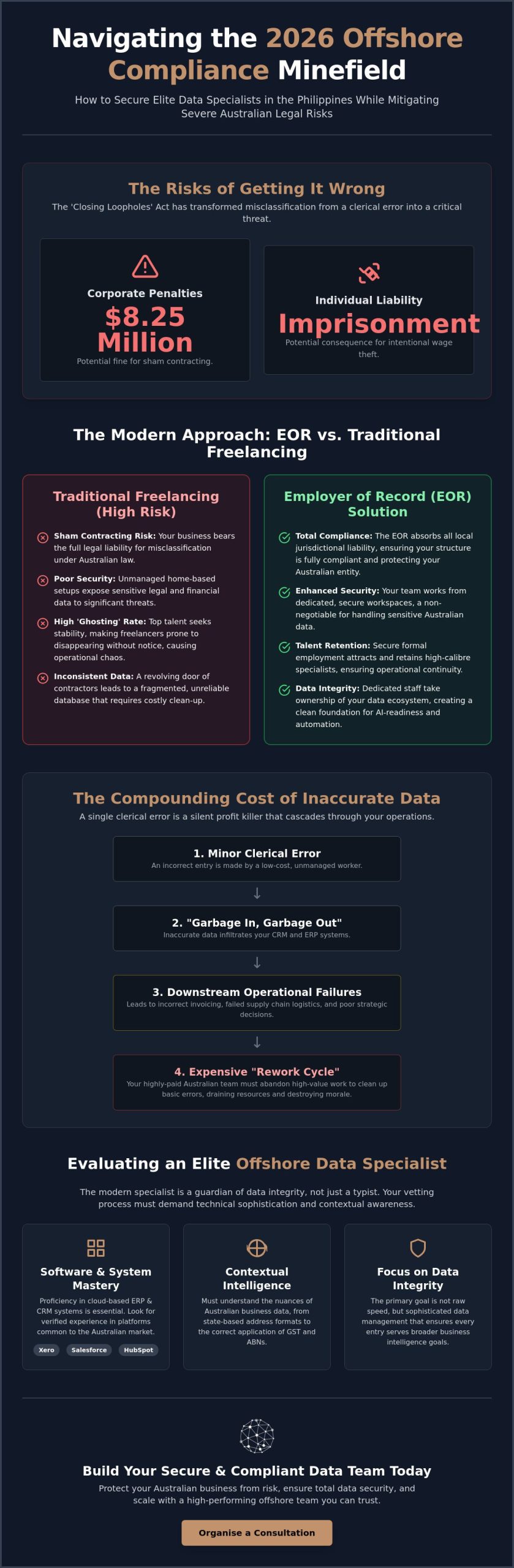
In 2026, a misclassified offshore contract is no longer just a clerical error; it is a potential criminal offence carrying penalties of up to $8.25 million for companies or even imprisonment for intentional wage theft. While the cost benefits of hiring an offshore data entry specialist in the Philippines remain compelling, the Australian regulatory landscape has become a minefield for the unprepared. You likely recognise that your business needs a clean, organised database to function, yet the anxiety regarding data security and the fear of ‘ghosting’ contractors often prevents you from scaling effectively.
This guide provides a definitive framework for securing elite talent while mitigating the severe risks associated with the Fair Work Act’s ‘Closing Loopholes’ provisions. You will discover how to establish a compliant employment structure that protects your Australian entity and ensures total data security. We will break down the ‘real substance’ legal test, the role of an Employer of Record in absorbing local liability, and the practical steps to maintain direct control over your staff without the legal burden of managing a foreign branch.
Key Takeaways
- Learn why a modern offshore data entry specialist must act as a guardian of data integrity, mastering cloud-based ERP systems rather than just performing basic clerical tasks.
- Discover why dedicated workspaces are non-negotiable for Australian firms handling sensitive legal or financial data, providing a level of security that home-based models cannot match.
- Navigate the complexities of the ‘Closing Loopholes’ Act to protect your Australian entity from the significant financial and criminal risks of sham contracting.
- Understand how an Employer of Record (EOR) service absorbs jurisdictional liability, allowing you to scale a high-performing team in the Philippines with total peace of mind.
Beyond Simple Typing: Why Australian Firms Need an Offshore Data Entry Specialist
In 2026, the role of an offshore data entry specialist has transitioned from a basic clerical function into a critical position of data integrity. For Australian firms, the information housed within a CRM or ERP system is the primary driver of strategic planning. If this data is compromised by inaccuracies, the resulting “garbage in, garbage out” cycle cripple’s your ability to make informed decisions. This shift is a key component of the modern Business process outsourcing (BPO) landscape, where the focus has moved from ad-hoc task completion to structured, dedicated roles that serve as the foundation for AI-readiness.
The traditional freelance marketplace model often fails Australian SMEs because it lacks the necessary security and accountability frameworks. Relying on a revolving door of independent contractors creates a fragmented, unreliable database. Progressive businesses are now prioritising dedicated offshore staff who understand the Australian business context and take ownership of the data ecosystem. High-quality data is no longer a luxury; it’s a prerequisite for any firm looking to leverage automation and predictive analytics in a competitive market.
The True Cost of Inaccurate Data Entry
Inaccurate data is a silent profit killer. When clerical errors infiltrate your ERP systems, the financial loss extends far beyond the time spent on the initial task. These mistakes compound into significant downstream operational errors, such as incorrect invoicing or failed supply chain logistics. For businesses managing ecommerce fulfilment services australia, data precision is the difference between a satisfied customer and a lost sale. This creates a “rework cycle” where your onshore Australian team must abandon high-value work to clean up basic errors. This doesn’t just drain your resources; it destroys team morale and erodes trust in your internal systems. Choosing a “cheap” freelance option often leads to expensive, multi-month data cleaning projects later.
EOR vs. Freelance: Securing Your Operational Continuity
The myth of the reliable independent contractor is a significant risk in the 2026 high-demand market. In the Philippines, top-tier talent seeks the security of formal employment, not the volatility of the freelance economy. By utilising an Employer of Record (EOR) model, you secure operational continuity and genuine accountability. This structure prevents the “ghosting” culture prevalent in non-managed offshore models. An EOR provides a clear, compliant framework that ensures your offshore data entry specialist is retained, integrated into your business culture, and held to the same standards as your local team. This protects your business from the sudden loss of institutional knowledge and the security risks associated with unmanaged remote access.
Evaluating Competencies: What to Look for in a Specialist
Hiring an offshore data entry specialist requires a shift in focus from raw speed to technical sophistication. In the current Australian business environment, a specialist who merely transcribes data without understanding its purpose is a liability. You need a professional capable of managing complex data flows within cloud-based ERP and CRM systems, ensuring every entry serves your broader business intelligence goals. High-level technical proficiency is the first line of defence against the operational errors that often plague unmanaged teams.
For those in the building and construction sector, this sophistication includes the ability to manage site logs and project data within specialised tools such as newbuildlog.com.
Effective data management also demands “contextual intelligence.” This means your specialist must understand the nuances of Australian business data, from specific state-based address formats to the correct application of GST. If a worker cannot distinguish between a valid Australian Business Number (ABN) and a random string of numbers, your financial reporting will inevitably suffer. When structuring these roles, avoiding sham contracting risks is essential. You must ensure your recruitment partner provides a compliant framework that treats these specialists as integral team members rather than disposable, ad-hoc contractors.
Software and System Familiarity
Your vetting process must move beyond basic Excel skills. It’s vital to verify experience in platforms ubiquitous to the Australian market, such as Xero, Salesforce, and HubSpot. A specialist should understand how these systems interact to maintain data hygiene across your entire tech stack. If you’re unsure how to assess these technical capabilities, our recruitment services can help you identify talent with proven experience in your specific industry platforms. Data hygiene is the foundation of 2026 business intelligence.
The Vetting Process: Quality Over Quantity
CVs are often unreliable indicators of performance in the Philippine market. We recommend skill-based testing that evaluates logical data processing rather than simple keystrokes per minute. A specialist must demonstrate the ability to identify anomalies and flag them to your Australian headquarters before they become systemic issues. This requires a high level of verbal and written communication to ensure nothing is lost in translation.
Implementing a robust Quality Assurance (QA) framework, such as a double-entry system or a peer-review cycle, ensures that accuracy remains the priority. If a specialist is left to work in isolation without these checks, the risk of downstream errors increases exponentially. Proactive communication is what separates a high-performing specialist from a basic data processor. By assessing for logical reasoning during the interview stage, you secure an asset who doesn’t just enter data but actively protects its integrity.
Infrastructure and Security: Protecting Your Data in the Philippines
The vulnerability of unmanaged remote work represents a significant operational risk for Australian firms. While the ‘Work From Home’ (WFH) model gained popularity for its flexibility, it is fundamentally unsuitable for sensitive data entry tasks. An offshore data entry specialist operating from a residential environment lacks the physical and digital safeguards required to protect Australian financial or legal information. Without a controlled perimeter, your business is exposed to unauthorised data access, unstable internet connectivity, and a lack of direct oversight.
For businesses handling high-stakes data, dedicated workspaces are non-negotiable. We implement Australian-standard cybersecurity protocols within our Philippine operations to ensure your data remains within a secure, audited environment. This includes on-the-ground support and management presence in hubs like Bacolod and Manila. This physical oversight ensures that staff follow strict security mandates, providing a level of protection that abstract digital platforms simply cannot offer. It’s about building a “compliance shield” that extends from your Australian office to our Philippine centres.
Hardware and Equipment Leasing
Securing your data begins with the physical device. Personal laptops often lack the necessary encryption and security patches required for corporate compliance. By utilising centralised equipment leasing, you ensure your team uses enterprise-grade hardware that is standardised across your organisation. This allows us to manage software updates and critical security patches across the Coral Sea, mitigating the risk of vulnerabilities that arise from outdated systems. We provide the tangible infrastructure that supports your digital security.
Data Privacy Compliance: AU and PH Standards
Navigating the intersection of the Australian Privacy Act and the Philippine Data Privacy Act of 2012 requires specialised expertise. A dedicated workspace Philippines serves as a physical firewall against data breaches, ensuring that only authorised personnel interact with your systems. Within our Employer of Record (EOR) structure, we provide robust contractual protections for your Intellectual Property (IP). This legally binds the staff to your standards while we absorb the jurisdictional complexities of Philippine labour law. This dual-layered approach ensures your operational freedom remains uncompromised by regulatory friction, allowing your offshore data entry specialist to work within a secure, legally defensible framework.
Navigating the Legal Landscape: Avoiding Sham Contracting Risks
The regulatory environment for Australian businesses employing staff in the Philippines has undergone a fundamental shift. Following the ‘Closing Loopholes’ legislation, the legal test for determining employment status now rests on the “real substance, practical reality and true nature of the relationship.” If you exert significant control over how your offshore data entry specialist performs their work, providing equipment and set hours, Australian regulators may deem them an employee regardless of any written ‘independent contractor’ agreement. This misclassification creates an immediate and severe liability for your directors.
MyBPO serves as your “compliance shield” in this complex jurisdictional overlap. We understand that Australian directors can be held personally liable for unpaid superannuation through Director Penalty Notices, while simultaneously facing scrutiny from the Philippine Department of Labor and Employment (DOLE). By utilising our structured employment model, you transfer the burden of local labour code adherence to us. We manage the selection, wages, and dismissal powers, ensuring that the ‘Four-Fold Test’ used in the Philippines is satisfied while protecting your Australian entity from regulatory overreach.
The Sham Contracting Trap
The Australian Taxation Office (ATO) and the Fair Work Ombudsman (FWO) are now actively investigating offshore arrangements designed to circumvent payroll tax and superannuation obligations. As of 2026, intentional wage theft, which includes many sham contracting arrangements, is a criminal offence. Companies face fines of up to $8.25 million, and individuals risk up to 10 years imprisonment. The sham contracting Philippines risk is no longer just a financial threat; it is a matter of corporate survival. An Employer of Record (EOR) model is the only legally robust way to secure long-term talent without the liability of a foreign branch.
Philippine Labour Law Compliance
Philippine labour laws are highly protective and require meticulous administration. Employers must manage mandatory contributions, including 10% for the Social Security System (SSS) and 2.5% for PhilHealth, alongside Pag-IBIG funds. Failure to pay these, or the mandatory ’13th-month pay,’ is a primary indicator of a sham contracting arrangement to both Australian and Philippine authorities. Navigating these requirements requires a partner with a deep local presence. Utilising an employer of record Australia allows you to scale your team safely, knowing that every statutory benefit is paid correctly and on time.
If you are concerned about your current offshore arrangements, you can secure your operations with MyBPO and eliminate your exposure to these escalating legal risks.
Building Your Secure Data Entry Team with MyBPO
MyBPO provides a unique bridge between Australian operational standards and Philippine talent. As an Australian-owned entity with a physical presence in both Manila and Bacolod, we act as a “safe harbour” for businesses navigating cross-border complexities. We don’t just facilitate hiring; we provide a robust structural framework that ensures your offshore data entry specialist is a high-performing asset from day one. This local presence allows us to manage the tangible infrastructure and human elements that digital-only platforms ignore.
The transition from a single specialist to a dedicated data department is a strategic move that requires a scalable foundation. By integrating offshore talent directly into your Australian centre of operations, you create a seamless flow of information that supports your broader business goals. Our role is to ensure this integration is both secure and compliant, allowing you to focus on growth while we manage the foundational risks of international employment.
Recruitment and Onboarding
Our offshore recruitment Philippines methodology is designed to isolate the top 5% of data talent. We vet candidates for technical proficiency in ERP systems and their ability to align with the Australian work style. This process includes training specialists on the specific “tone of voice” and cultural nuances required to work effectively with Australian teams. By setting clear KPIs that drive accuracy and throughput from the start, we eliminate the ambiguity that often leads to underperformance in remote roles.
Direct Control, Zero Liability
The MyBPO model allows you to maintain direct control over your staff’s daily workflow without the legal liability of managing a foreign branch. While you direct the tasks and manage the output, we absorb the complexities of Philippine labour law, payroll, and statutory compliance. This arrangement provides total operational freedom; you gain the benefits of a dedicated offshore data entry specialist while we act as the legal employer of record.
MyBPO protects Australian company directors from offshore regulatory breaches by assuming all local employment risks and ensuring total adherence to both Philippine and Australian compliance frameworks. With physical offices in Brisbane, Manila, and Bacolod, we provide a level of accountability that is grounded in physical reality. This structure allows you to scale your operations with complete peace of mind, knowing your data and your legal standing are secure.
Secure Your Operational Future with Compliant Data Management
The 2026 regulatory environment for Australian firms is unforgiving, yet the opportunity to scale with elite Philippine talent remains a powerful competitive advantage. Success hinges on moving beyond the high-risk freelance model and embracing a structured, secure approach. You’ve seen how a dedicated offshore data entry specialist serves as a guardian of your data integrity, provided they’re supported by enterprise-grade infrastructure and a robust legal framework that absorbs jurisdictional risk.
MyBPO provides the compliance shield necessary to navigate these complexities. As an Australian-owned and operated business with local Brisbane representation, we provide the jurisdictional security that digital platforms lack. Our physical offices in Manila and Bacolod ensure total workforce oversight, while our expertise in AU-PH cross-border compliance mitigates the risk of sham contracting and data breaches. You can now build a high-performing team without compromising your legal standing or operational security.
Secure your offshore team today with MyBPO’s compliant EOR services and gain the operational freedom to focus on your core business. We’re ready to help you bridge the gap between two worlds with confidence and clarity.
Frequently Asked Questions
Is an offshore data entry specialist legally considered an employee in Australia?
Under the Closing Loopholes Act 2024, the legal status of a worker depends on the real substance and practical reality of the relationship. If you exert significant control over their hours, provide their equipment, and require exclusive service, Australian regulators may deem them an employee. This classification triggers mandatory superannuation and payroll tax obligations, regardless of any written ‘contractor’ agreement you have in place.
How do I ensure my data is secure when hiring in the Philippines?
Security is maintained by avoiding unmanaged ‘Work From Home’ models and utilising dedicated workspaces. These centres implement Australian-standard cybersecurity protocols and physical access controls. By providing staff with enterprise-grade hardware through equipment leasing, you ensure all security patches and encryption are managed centrally, preventing the vulnerabilities associated with personal laptops and unsecured home networks.
What is the difference between a BPO and an Employer of Record (EOR) for data entry?
A BPO typically manages the entire project output, whereas an EOR legally employs the staff on your behalf. An EOR absorbs the jurisdictional liability and manages local payroll, tax, and statutory compliance in the Philippines. This allows you to maintain direct management of your offshore data entry specialist and their daily workflow without the legal burden of establishing a foreign subsidiary.
Do I need to pay the 13th-month pay to my offshore specialist?
Yes, the 13th-month pay is a mandatory statutory requirement under Philippine labour law for all rank-and-file employees. It must be paid by December 24th each year. Failure to provide this benefit is a major red flag for sham contracting. Our EOR structure ensures all such mandatory benefits are correctly calculated and paid, protecting your business from local and Australian regulatory scrutiny.
Can an offshore data entry specialist work during Australian business hours?
Yes, specialists are typically scheduled to align with Australian time zones, such as AEST or AWST. This synchronisation allows for real-time communication and ensures that any data anomalies are flagged and resolved during your standard operating hours. This alignment is critical for maintaining the ‘contextual intelligence’ required to process Australian business data accurately and efficiently.
What happens if my offshore staff member misuses company data?
In a managed office environment, physical and digital monitoring significantly reduces the risk of data misuse. If a breach occurs, the EOR structure provides a clear legal framework for disciplinary action under Philippine law. This is a primary reason why unmanaged freelance models are high-risk; without a local legal employer, you have limited recourse if a remote contractor violates your intellectual property or data privacy.
How does the ‘Closing Loopholes’ Act affect my offshore team in 2026?
The Act has introduced severe penalties for sham contracting, with fines for companies reaching up to $99,000 for small businesses and significantly higher for larger entities. Intentional wage theft, which can include misclassifying employees as contractors to avoid superannuation, is now a criminal offence. Your offshore arrangements must be structurally robust to withstand the ‘whole of relationship’ test applied by the Fair Work Ombudsman.
What software should my offshore data entry specialist be proficient in?
Your specialist should be proficient in cloud-based ERP and CRM platforms such as Xero, Salesforce, and HubSpot. Beyond basic data entry, they must understand Australian-specific requirements like GST application, ABN verification, and local address formats. This technical proficiency ensures that your database remains clean and ready for AI integration, rather than requiring expensive manual cleaning by your onshore Australian team later.
Need a strategy session?
Tell us about your team and we will map out the right structure, fixed-cost quote included.
Book a call