Blog
Risks of Hiring Overseas Workers: A 2026 Guide for Australian Businesses

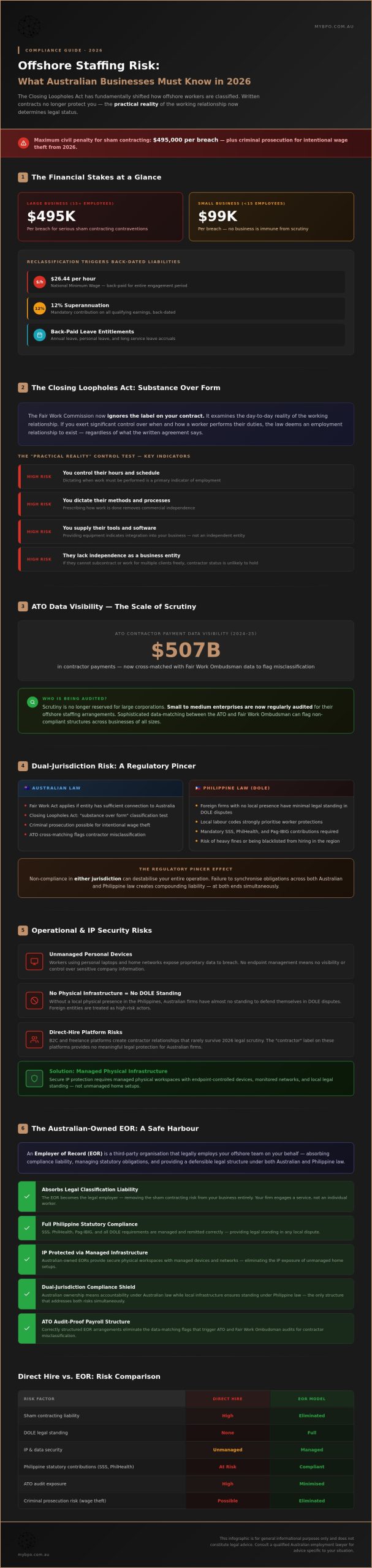
Your written contract no longer serves as an absolute shield against the Fair Work Ombudsman. With the full implementation of the Closing Loopholes Act in 2026, the “practical reality” of a working relationship now dictates its legal status, meaning many Australian firms are unknowingly exposed to the risks of hiring overseas workers through non-compliant structures. If the Fair Work Commission deems your offshore contractor an employee, a large business could face civil penalties of up to $495,000 per breach, while intentional wage theft now carries the threat of criminal prosecution.
It’s understandable that you feel a sense of unease when managing a distributed team across jurisdictional boundaries. You want the operational advantages of global talent without the constant anxiety of IP theft or a surprise audit from the ATO. This guide identifies the specific legal, financial, and operational pitfalls of offshore staffing and provides a clear framework to mitigate them. We will examine the 2026 regulatory shifts, the necessity of physical infrastructure for IP security, and how an Australian-owned Employer of Record acts as a safe harbour for your enterprise.
Key Takeaways
- Understand how the 2026 Closing Loopholes Act prioritises the “practical reality” of work over written contracts, shifting the legal burden of classification onto Australian employers.
- Identify the critical risks of hiring overseas workers via direct-hire platforms to avoid Fair Work penalties that can reach $495,000 for sham contracting breaches.
- Establish a secure operational framework that protects your intellectual property and data through managed physical infrastructure rather than relying on unmanaged personal devices.
- Navigate the complexities of Philippine labour law by ensuring full compliance with mandatory DOLE requirements and statutory contributions like SSS and PhilHealth.
- Utilise an Australian-owned Employer of Record (EOR) to absorb legal liability and provide a robust compliance shield for your offshore staffing operations.
The Regulatory Landscape: Risks of Hiring Overseas Workers in 2026
Offshore employment risk is the cumulative legal and financial liability arising when an Australian business engages international talent without aligning with both domestic industrial relations laws and foreign labour codes. It’s a dual-threat environment. You aren’t just managing a remote team; you’re managing two distinct, often conflicting, legal systems. Failure to synchronise these obligations creates a regulatory pincer movement that can destabilise your entire operation. To protect your business from these complexities, engaging with specialists such as MyGen Insurance Brokers can provide the necessary risk management and insurance solutions to shield your Australian enterprise.
The Australian government has intensified its focus on offshore labour supply chains to prevent the erosion of local employment standards. In the 2024-2025 financial year, the ATO already had visibility over $507 billion in contractor payments. By 2026, data-matching between the ATO and the Fair Work Ombudsman has become sophisticated enough to flag businesses that treat overseas workers as contractors when the practical reality of their role suggests they’re employees. This scrutiny is no longer reserved for large corporations; small to medium enterprises are now regularly audited for their offshore staffing arrangements.
The Impact of the Closing Loopholes Act
The 2026 regulatory environment is defined by the “substance over form” principle. Under the Closing Loopholes Act, the Fair Work Commission ignores the label on your contract. If you exert significant control over when and how a worker performs their duties, you’ve likely created an employment relationship. The risks of hiring overseas workers through a direct-hire model include being categorised as a joint employer. This means you’re liable for the National Minimum Wage of $26.44 per hour, a 12% superannuation contribution on qualifying earnings, and back-paid leave. Large businesses with 15 or more employees face civil penalties of $495,000 per breach for serious contraventions of sham contracting rules.
Jurisdictional Complexity: Which Laws Apply?
Assuming Australian law doesn’t apply to remote staff is a dangerous misconception. While the “proper law” of a contract often dictates which jurisdiction governs the agreement, Australian courts frequently apply the Fair Work Act to any entity with a sufficient connection to Australia. Conversely, foreign courts, particularly in the Philippines, view Australian firms without a local presence as high-risk actors. If a dispute reaches the Philippine Department of Labor and Employment (DOLE), a foreign entity with no physical infrastructure has almost no standing to defend itself. You’re left vulnerable to local labour codes that prioritise the worker, often resulting in heavy fines or being blacklisted from hiring in that region.
This requirement for a local presence is equally critical for Australian firms manufacturing in the region; for these enterprises, Buying Office Asia provides essential on-the-ground procurement and sourcing oversight via bo-asia.com.
Sham Contracting and Misclassification: The #1 Financial Threat
Direct hiring through freelance marketplaces or B2C platforms is often perceived as a cost-effective shortcut. In reality, it represents the most significant financial vulnerability for Australian firms today. These platforms facilitate a “contractor” relationship that rarely survives the rigorous legal scrutiny of 2026. If the Fair Work Ombudsman determines that your offshore staff operate under your direct supervision, use your provided software, and lack the independence of a true business entity, they’ll reclassify them as employees. This reclassification triggers a cascade of back-dated liabilities that can cripple an enterprise’s cash flow.
The criteria for identifying sham contracting have moved beyond the written word of a contract to focus on the practical nature of the daily workflow. If you control their hours, dictate their methods, and provide their tools, you’ve likely created an employment relationship. The financial consequences are severe. For a single instance of worker misclassification, a large business with 15 or more employees faces a maximum civil penalty of $495,000 for a serious contravention. Even small businesses aren’t immune, with penalties reaching $99,000 per breach.
The “Contractor” Trap in the Philippines
Philippine workers frequently prefer the security of “employee” status because it provides access to essential social security benefits that contractors must fund themselves. This creates a misalignment of interests. If a worker feels their rights are being bypassed, they can seek intervention from the local Department of Labor and Employment (DOLE). You can read more about how this specific dynamic creates a sham contracting Philippines risk for Australian firms. Maintaining strict Compliance with Philippine Labour Law (DOLE) is impossible for a foreign entity without a local legal presence, leaving your business exposed to foreign litigation you cannot win.
Back-Pay and Entitlement Liabilities
Misclassification doesn’t just result in fines. It forces you to settle years of unpaid entitlements. This includes the mandatory 13th-month pay in the Philippines, which is a legal requirement often ignored by Australian firms using direct-hire models. A single complaint from a disgruntled former worker can trigger a comprehensive audit of your entire offshore operation by both Australian and Philippine regulators. Beyond the immediate cash drain, the reputational damage of being blacklisted by DOLE can permanently bar your organisation from accessing the Philippine talent pool. To prevent these risks of hiring overseas workers from manifesting, many firms are shifting to a secure Employer of Record services model that absorbs these liabilities on their behalf.
Operational and Security Risks: Protecting Your Intellectual Property
Intellectual property remains your most valuable asset, yet it is also the most vulnerable when operating across borders. While the legal risks of hiring overseas workers are often discussed in terms of payroll compliance, the operational threat to your proprietary data is equally severe. Physical distance creates a “visibility gap” where Australian managers lose sight of how data is handled on a minute-by-minute basis. Without a local entity to oversee operations, maintaining a strict chain of custody for sensitive client information becomes almost impossible. If a data breach occurs five thousand kilometres away, your ability to contain the fallout is limited by your lack of physical control.
Hardware Vulnerabilities and Data Sovereignty
Relying on “Bring Your Own Device” (BYOD) policies is a significant liability for Australian professional services. When offshore staff use personal, unmanaged devices, they often connect via unsecured public Wi-Fi or use outdated hardware that lacks essential security patches. This environment is a primary source of data breaches. To secure your perimeter, transitioning to a dedicated workspace Philippines ensures that your team operates within a controlled, enterprise-grade network. Professional services firms must prioritise mitigating risk at the infrastructure level to prevent catastrophic data leaks that could terminate your Australian client contracts. Without managed hardware, you have no way to verify that your data isn’t being stored on personal cloud accounts or shared through unauthorised channels.
Enforcing Non-Compete and Confidentiality Clauses
Many Australian directors mistakenly believe their standard employment contracts will protect them in a Manila court. In reality, an Australian contract is often unenforceable in the Philippines without a local legal presence to initiate proceedings. If a staff member violates a non-compete clause or leaks trade secrets, your Australian entity has no jurisdictional standing to hold them accountable. Securing your trade secrets requires a local “Employer of Record” who can enforce confidentiality agreements within the worker’s home jurisdiction. This local presence acts as a deterrent, ensuring that staff understand the real-world consequences of IP theft. It bridges the gap between Australian expectations and Philippine legal realities, allowing you to scale with confidence without leaving your trade secrets exposed to jurisdictional voids.
Compliance with Philippine Labour Law (DOLE)
While Australian directors often focus on Fair Work compliance, the risks of hiring overseas workers extend deep into the Philippine legal system. The Philippine Department of Labor and Employment (DOLE) maintains a staunchly pro-worker stance, governed by a labour code that is significantly more prescriptive than many Australian business owners anticipate. Managing a distributed team without a local legal presence means you’re operating in a jurisdictional blind spot. You’re not just managing staff; you’re navigating a complex web of social protections that the Philippine government enforces with rigorous oversight.
A common point of friction for Australian firms is the 13th-month pay. This is a non-negotiable statutory requirement, not a discretionary performance bonus. Under Philippine law, all rank-and-file employees who have worked for at least one month are entitled to this payment, regardless of their designation. Failing to factor this into your financial forecasting creates an immediate 8.33% budget shortfall and opens the door to “Illegal Dismissal” claims. In the Philippines, the burden of proof in termination cases lies entirely with the employer. If a dismissal is found to be procedurally or substantively flawed, the settlement costs often include full back-wages, benefits, and significant moral damages.
Mandatory Benefits and Statutory Contributions
Employer obligations in the Philippines centre on the “Big Three” contributions: Social Security System (SSS), PhilHealth (medical insurance), and Pag-IBIG (Home Development Mutual Fund). These aren’t optional perks; they’re the bedrock of the local social safety net. If a single contribution is missed or delayed, the consequences aren’t merely financial. Under Philippine law, the failure to remit these payments can lead to criminal liability for company directors. To ensure your firm remains on the right side of these regulations, refer to our comprehensive guide on payroll Philippines for Australian companies to understand the exact mechanics of statutory remittance.
Public Holidays and Leave Entitlements
The Philippine holiday calendar is notoriously complex, categorised into Regular Holidays and Special Non-Working Days. Each category carries different premium pay requirements, sometimes reaching 200% of the daily rate. Mismanaging these entitlements is a primary driver of “ghosting” and high turnover. Philippine workers expect their employers to respect local statutory requirements, including Service Incentive Leave (SIL) for those who have completed one year of service. When an Australian firm ignores these cultural and legal nuances, it erodes trust and exposes the enterprise to the operational risks of hiring overseas workers through unmanaged channels. To secure your operations against these regulatory pitfalls, explore our Employer of Record services today.
Mitigating Risk: The Australian-Owned EOR Shield
The risks of hiring overseas workers are no longer theoretical; they are a direct threat to your balance sheet under the 2026 regulatory framework. Transitioning from “freelance chaos” to “corporate compliance” requires a structural shift in how your business engages international talent. An Employer of Record Australia acts as a compliance shield, positioning itself between your enterprise and the complexities of foreign labour codes. By utilising this model, you move away from the high-risk direct-hire approach and into a managed environment where every regulatory box is ticked by specialists.
MyBPO absorbs the legal liability of employment by becoming the formal employer in the Philippines. This arrangement ensures that your Australian entity is not the party responsible for statutory contributions, payroll taxes, or DOLE compliance. If a labour dispute arises, the burden of resolution falls on our local entity, not your Brisbane or Sydney office. This separation is vital for protecting your Australian assets from foreign litigation. Having Australian owners on the ground in both Brisbane and Manila provides a unique advantage; we understand the high standards of Fair Work alignment while possessing the local knowledge to navigate Philippine jurisdictional boundaries effectively.
The MyBPO Advantage: Local Support, Global Security
Our physical presence in Manila ensures that your staff are vetted and their working environments are secured. Unlike digital-only platforms, we provide Dedicated Workspaces that eliminate the security vulnerabilities of home-based work. This infrastructure allows us to secure your hardware and manage data sovereignty, directly addressing the IP risks discussed earlier. 2026 is the year to formalise your offshore team. As the Fair Work Ombudsman and the ATO increase their data-matching capabilities, the window for “grey area” contracting is closing. We provide the peace of mind that comes from knowing your offshore operations are built on a foundation of total compliance.
Next Steps for Secure Offshore Expansion
Securing your enterprise begins with a thorough risk audit of your current offshore arrangements. If you are currently paying staff via PayPal or freelance marketplaces, your business is likely exposed to significant misclassification liabilities. Transitioning these contractors to a compliant EOR structure is a methodical process that preserves your talent while eliminating your legal exposure. This transition demonstrates to regulators that your firm is committed to ethical and lawful employment practices. We invite you to contact MyBPO for a confidential compliance consultation to evaluate your current offshore footprint and secure your path toward sustainable global growth.
Securing Your Enterprise Against Regulatory Volatility
The 2026 landscape for offshore staffing is no longer a permissive environment for unmanaged contractors. As the Fair Work Ombudsman and ATO increase their oversight, the practical reality of your employment relationships takes precedence over any written agreement. Failing to align your operations with both Australian standards and Philippine labour codes creates a liability that few enterprises can absorb. To navigate the risks of hiring overseas workers, your business must move from fragmented freelance models to a structured compliance framework. This transition includes securing your intellectual property through managed physical infrastructure and ensuring every statutory contribution is remitted with precision.
As an Australian-owned and operated compliance specialist with physical offices in Brisbane, Manila, and Bacolod, MyBPO provides a zero-liability EOR model designed specifically for the Australian market. Secure your offshore team with an Australian-owned EOR – Contact MyBPO today. You can achieve the operational freedom of global talent without the legal blowback. With the right compliance shield in place, your business is free to scale with confidence and security.
Frequently Asked Questions
What are the main risks of hiring overseas workers for an Australian company?
The primary risks include legal misclassification under Australian industrial relations law, financial penalties for non-compliance with foreign labour codes, and operational vulnerabilities regarding data security. These risks often manifest when a business lacks local physical infrastructure or a legal entity in the worker’s jurisdiction. Without a structured compliance framework, your enterprise remains exposed to both domestic audits and international litigation that can destabilise your cash flow and reputation.
Can the Fair Work Ombudsman penalise me for hiring staff in the Philippines?
Yes, the Fair Work Ombudsman can impose significant penalties if your offshore staffing arrangement is deemed to be a sham contracting relationship. Under 2026 regulations, large businesses face civil penalties of up to $495,000 per breach for serious contraventions. The Ombudsman focuses on the practical reality of the work relationship, meaning a written contract alone won’t protect you from Australian oversight if the worker operates as an employee.
How does the Closing Loopholes Act affect my offshore contractors?
The Closing Loopholes Act shifts the legal focus from the terms of a written contract to the real substance and practical nature of the employment relationship. If your offshore contractors perform work under your direct control and supervision, they may be legally classified as employees under Australian law. This change exposes firms to retroactive liabilities for leave, superannuation, and the national minimum wage of $26.44 per hour.
What is sham contracting in an offshore context?
Sham contracting in an offshore context occurs when an Australian business misclassifies a worker as an independent contractor to avoid paying employee entitlements, despite the worker operating as an employee. This is one of the most significant risks of hiring overseas workers because it triggers massive retroactive financial liabilities. Regulators look at factors like control over hours, provision of equipment, and whether the worker truly operates an independent business.
Do I need to pay superannuation for workers located overseas?
You are generally required to pay superannuation if the worker is classified as an employee under the practical reality test, even if they are located overseas. As of July 2026, the superannuation guarantee rate is 12% of qualifying earnings. Payments must reach the employee’s account within seven days of their salary or wages, making compliance a complex administrative burden for firms without a local Employer of Record to manage the process.
How can I protect my intellectual property when hiring offshore staff?
Protecting your intellectual property requires a combination of local legal standing and physical infrastructure security. Australian contracts are often unenforceable in foreign courts without a local legal presence to initiate proceedings. Utilising a dedicated workspace and an Australian-owned Employer of Record ensures that confidentiality clauses are enforceable in the worker’s home jurisdiction while preventing data breaches that typically occur when staff use unmanaged personal devices on unsecured networks.
Is an Employer of Record (EOR) the same as a recruitment agency?
An Employer of Record (EOR) is the legal employer of your staff, whereas a recruitment agency simply identifies talent for you to hire directly. While a recruiter leaves you with the full burden of compliance and liability, an EOR absorbs the legal and financial risks of hiring overseas workers. This includes managing payroll, taxes, and mandatory statutory contributions like SSS and PhilHealth in the Philippines, acting as your compliance shield.
What happens if my offshore worker makes a legal claim against my business?
If an offshore worker makes a legal claim, an Australian business without a local entity has almost no standing to defend itself in a foreign labour court. Settlement costs for illegal dismissal in the Philippines can be substantial, often including full back-wages and moral damages. An EOR acts as your local legal representative, taking on the responsibility for legal defence and absorbing the associated liabilities to protect your Australian enterprise.
Need a strategy session?
Tell us about your team and we will map out the right structure, fixed-cost quote included.
Book a call