Blog
Cultural Differences Australia vs Philippines Workplace: The 2026 Management Guide
Why does your Philippine team say “yes” to every deadline, only for the project to stall without warning? This isn’t a lack of competence; it’s a breakdown in cultural alignment that creates significant operational risk for your business. You likely feel the frustration of communication gaps that lead to project delays, or the quiet anxiety of high staff turnover when your offshore team doesn’t feel integrated. It’s a common challenge for Australian managers who value a “fair go” and directness but find themselves hitting a wall of polite silence.
Understanding the cultural differences australia vs philippines workplace is not just about being polite; it’s a critical strategy to protect your business from friction and inefficiency. This 2026 management guide will show you how to master these nuances to mitigate operational risks and build a high-performance Philippine team. We will provide a structured framework for giving feedback that actually sticks, strategies to increase retention rates, and the practical steps needed to weave offshore staff into your local Australian company culture without compromising on performance or compliance.
Key Takeaways
- Identify why cultural friction leads to operational “leakage” and learn specific strategies to align team expectations for maximum productivity.
- Master the nuances of cultural differences australia vs philippines workplace by contrasting Australian egalitarianism with the Philippine respect for hierarchy.
- Decode indirect communication and the concept of “Hiya” to ensure your staff feel secure enough to report errors and challenge flawed instructions.
- Establish robust management protocols, such as relationship-focused daily huddles, to bridge the gap between Australian directness and local cultural norms.
- Leverage an Employer of Record (EOR) framework to mitigate jurisdictional risks and secure a seamless integration of offshore staff into your business.
Understanding the Cultural Landscape: Why Alignment Matters in 2026
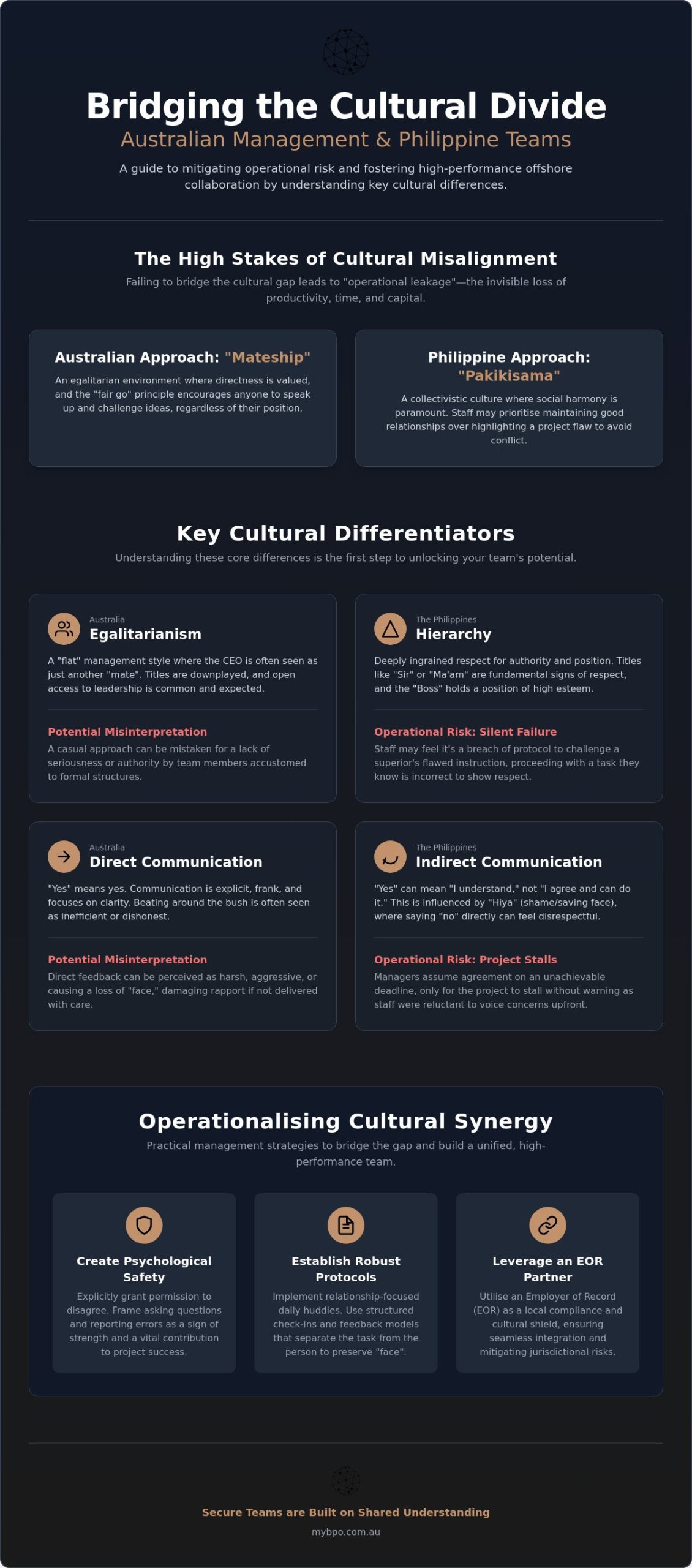
The “Cultural Gap” in the Australian-Philippine offshore corridor is not merely a difference in time zones or accents. It’s a fundamental divergence in how work is perceived, delegated, and delivered. In 2026, failing to bridge this gap results in operational “leakage.” This is the invisible loss of productivity through repeated instructions, missed deadlines, and increased management overhead. When your team in Manila nods in agreement but the deliverables don’t match the brief, you aren’t just losing time. You are burning capital on management hours that should be spent on growth. Cultural Risk Mitigation is now a business necessity for any firm looking to secure their offshore operations and maintain structural integrity.
Australian managers often lead through “mateship” and the “fair go,” assuming an egalitarian environment where anyone can speak up. Conversely, Philippine workplace culture is rooted in collectivism and “Pakikisama,” or social harmony. This difference often leads to a situation where a Filipino staff member prioritises harmony over highlighting a project flaw. This creates a silent risk for the Australian director who expects blunt honesty. Understanding the cultural differences australia vs philippines workplace is the first step in dismantling these barriers and protecting your operations from avoidable friction.
The High Stakes of Miscommunication
Cultural friction is more than an interpersonal hurdle. It’s a legal liability. Misunderstandings regarding job roles and control can lead to an Australian firm inadvertently exposing the sham contracting Philippines risk. If a manager treats an offshore contractor like a direct employee without the right structural protections, they face significant Fair Work penalties. Poor integration is also the primary driver of high staff attrition. High staff turnover is not an inevitability of offshoring. It’s often a symptom of cultural friction where the staff member feels their “face” is at risk during standard Australian-style performance reviews. Cultural Synergy is the deliberate alignment of Australian operational expectations with precise Philippine execution.
Cultural Competence as a Competitive Advantage
By 2026, the era of viewing the Philippines as a source of “cheap labour” has ended. Savvy Australian businesses now focus on building integrated global teams that function as a single unit. Utilising an employer of record Australia allows companies to bridge these gaps by providing a local “compliance shield” that understands both jurisdictions. This deep understanding of the Filipino-Australian community and its professional values accelerates your speed-to-market. It allows you to move past the “getting to know you” phase and straight into high-performance output. Secure teams are built on shared understanding, not just shared spreadsheets.
Hierarchy vs Egalitarianism: Navigating Authority and Decision-Making
Australia’s “flat” management style often clashes with the Philippines’ deeply ingrained respect for authority. In a typical Australian office, the CEO is often just another “mate” you can approach in the kitchen. In the Philippines, the workplace is traditionally hierarchical. This difference is starkly visible in the use of titles like “Sir” or “Ma’am.” While an Australian manager might find these titles formal or even awkward, they are a fundamental sign of respect in Philippine culture. This isn’t just about social etiquette; it’s a structural reality that dictates how information flows through your organisation. If you don’t actively manage these cultural differences australia vs philippines workplace, you risk creating an environment where critical feedback is suppressed by a desire to show respect.
The operational danger lies in the “silent failure.” If a manager gives a flawed instruction, an Australian employee will likely call it out immediately. A Filipino staff member, however, may feel that challenging a “Boss” is a breach of protocol. They might proceed with a task they know is incorrect simply because they haven’t been given explicit permission to disagree. According to Hofstede’s cultural dimensions, the Philippines scores significantly higher in Power Distance than Australia. This data confirms that employees in the Philippines are culturally conditioned to accept an unequal distribution of power. To protect your business, you must deliberately dismantle this pedestal. Reward those who find errors and make it clear that professional disagreement is a requirement of the “fair go,” not a sign of disrespect.
The “Yes” Problem: Understanding Compliance vs Agreement
In the Philippine context, “yes” is often used as a social lubricant. It doesn’t always signal agreement or even comprehension. It frequently means “I hear you and I don’t want to disappoint you.” This is a stark contrast to the Australian “no worries” attitude, which usually implies the task is understood and under control. To mitigate the risk of project delays, managers should avoid closed questions. Instead of asking “Do you understand?”, ask “How do you plan to approach this task?” This forces a demonstration of understanding and identifies gaps before they become costly errors.
Empowering Individual Initiative
Australian managers often find it frustrating when staff wait for explicit permission for minor tasks. This “permission-seeking” is a survival mechanism in hierarchical cultures. Overcoming it requires creating “Safe Zones” where staff can offer feedback without fear of repercussion. Building this proactive culture starts at the hiring stage. Our offshore recruitment Philippines protocols specifically screen for candidates who demonstrate proactivity and a willingness to engage in flat structures. If you want a team that takes the lead, you must first secure a recruitment partner who understands these cultural levers.
Direct vs Indirect Communication: Reading Between the Lines of “Yes”
Australian workplace culture is built on a “tell it like it is” philosophy. We value brevity and directness, often viewing bluntness as a sign of honesty and efficiency. In the Philippines, this approach can be perceived as abrasive or even hostile. The primary driver behind this friction is the concept of “Hiya,” which translates roughly to a sense of shame or social propriety. For a Filipino professional, maintaining “face” is paramount. If an Australian manager delivers sharp, public criticism, it triggers a profound sense of Hiya, which often leads to the staff member withdrawing rather than improving. This is one of the most volatile cultural differences australia vs philippines workplace managers must navigate to maintain operational integrity.
Parallel to Hiya is “Pakikisama,” or the practice of yielding to the will of the group to maintain social harmony. While Australians value individual accountability, many Philippine teams prioritise the collective experience. If a manager disrupts this harmony through aggressive communication, the team’s internal support structure can fracture. This isn’t just a “soft” HR issue. It has tangible consequences for the Australia-Philippines relationship at a corporate level, as it directly impacts your team’s willingness to report risks before they escalate into failures. To lead effectively, you must learn to deliver feedback privately and with a degree of “softness” that preserves the individual’s dignity while maintaining your high standards.
The Art of the “Soft” No
You won’t often hear a flat “no” from your Philippine team. Instead, you might encounter phrases like “I will try my best” or “I’ll see what I can do,” often accompanied by a slight hesitation in tone. These are cultural signals for “this is not possible.” If an Australian manager ignores these cues and pushes for a definitive “yes,” they often inadvertently force the staff member into a corner. This pressure frequently results in “ghosting” or sudden resignations as the staff member chooses to leave rather than face the Hiya of failing a direct request. Successful managers learn to listen for the silence between the words.
Building Trust Through “Pakikisama”
In Australia, we often view small talk as a distraction from “real work.” In the Philippines, relationship-building is the work. Your team needs to feel like they are part of a professional “family” to perform at their peak. This trust is built on reliability and mutual respect. For instance, ensuring your payroll Philippines for Australian companies is executed with absolute precision is a powerful way to demonstrate that you value their contribution. When the basics like compensation are secure and handled with local expertise, it provides the psychological safety required for your staff to move past Pakikisama and engage in the honest, direct communication your business needs.
Operationalising Cultural Synergy: Management Strategies that Work
Moving from cultural awareness to operational execution is where many Australian firms falter. While understanding the cultural differences australia vs philippines workplace is essential, you must embed this knowledge into your standard operating procedures to secure your investment. Verbal instructions alone are insufficient. In a culture where “saving face” is a priority, a staff member may not ask for clarification on a vague verbal request. Establishing clear, written protocols for every task provides a neutral reference point that bypasses the fear of hierarchy. It transforms a potentially awkward conversation into a simple check against a documented standard, ensuring that your expectations are met without causing social friction.
Implement “Daily Huddles” that dedicate the first few minutes to relationship-building. This mirrors the Philippine value of social harmony before pivoting to task updates. Additionally, you must respect local cultural milestones to maintain staff loyalty. The “13th-month pay,” a mandatory payment in the Philippines, is not merely a financial transaction; it is a significant marker of stability and professional respect. Failing to manage these expectations correctly can lead to sudden attrition and operational instability. Use collaborative tools to maintain a flat flow of information, allowing staff to contribute ideas in a digital space where the pressure of face-to-face hierarchy is reduced.
Feedback Loops and Performance Reviews
Transition your performance reviews from “top-down” assessments to “side-by-side” coaching sessions. This approach reduces the perceived threat to an employee’s professional standing. The “Sandwich Method,” which involves placing constructive criticism between two layers of positive reinforcement, is particularly effective in the Philippines. It allows you to maintain high standards without triggering the defensive withdrawal associated with “Hiya.” Your KPIs should reward individual results while also acknowledging contributions to team harmony, aligning your business goals with local values.
The Role of Physical Infrastructure
The environment in which your team works significantly influences their output and long-term commitment. Isolated remote work often exacerbates cultural drift and communication barriers. Utilising a dedicated workspace Philippines fosters a sense of professional pride and belonging that a home office cannot replicate. These centres provide the physical presence and human support needed to act as a “cultural translator” for your business. If you are ready to secure your team’s performance through a structured and professional environment, contact MyBPO to explore our dedicated workspace solutions.
MyBPO: Your On-the-Ground Cultural and Compliance Guardian
The successful management of cultural differences australia vs philippines workplace requires more than a handbook; it demands a physical presence that can intervene before cultural friction becomes an operational failure. MyBPO functions as your vigilant guardian in the AU-PH corridor. We are an Australian-owned and operated specialist that “speaks both languages,” ensuring your corporate values are never lost in translation. By positioning ourselves as a “compliance shield,” we provide the structural integrity needed to navigate the complexities of international employment. Our role is to absorb the administrative and cultural risks, allowing you to lead with confidence and focus on your core business objectives.
We maintain a physical representation in Brisbane, Manila, and Bacolod, creating a tangible “security blanket” for your operations. This human-centric approach moves beyond abstract digital platforms to offer real-world accountability. If a cultural misunderstanding arises or a regulatory shift occurs, our local experts are already on the ground to mitigate the impact. We understand the nuances of the Australian “fair go” and the Philippine “Pakikisama” because we live and work in both worlds daily. This dual-jurisdictional expertise is the foundation of a secure offshore future.
The MyBPO Difference: Beyond a Virtual Platform
Choosing an Australian-owned partner ensures that your business ethics and operational standards are protected at every level. Unlike generic B2C marketplaces, MyBPO provides a dedicated support structure for your Philippine workforce. We handle the “hard stuff”—from complex payroll tax calculations to the nuanced delivery of performance feedback—ensuring your team remains productive and compliant. Our Employer of Record (EOR) model is designed to secure your business against the liabilities of sham contracting and jurisdictional disputes. We provide the physical centres and the local management expertise that transform a group of offshore contractors into a high-performance, integrated team.
Next Steps for Secure Scaling
Securing your offshore future begins with a clear-eyed assessment of your current or planned team structure. We recommend starting with a cultural audit to identify potential friction points in your communication and management protocols. This proactive step allows us to tailor a recruitment and integration strategy that aligns with your specific requirements. Booking a consultation with our specialists provides you with a clear roadmap for secure scaling, backed by the certainty of local compliance and cultural alignment. Don’t leave your international expansion to chance. Secure your offshore team with MyBPO today and build your business on a foundation of total accountability and professional protection.
Securing Your Cross-Border Operational Integrity
Mastering the nuances of hierarchy and the indirect communication style of your offshore team is no longer an optional soft skill. It’s a fundamental risk management requirement for any firm operating in 2026. By implementing structured protocols and relationship-focused huddles, you move beyond mere delegation to true operational synergy. Navigating the cultural differences australia vs philippines workplace is a continuous process that requires both local insight and Australian professional standards to ensure long-term stability.
MyBPO acts as your on-the-ground guardian. As an Australian-owned and operated specialist, we provide the physical support centres in Manila and Bacolod necessary to anchor your team and mitigate turnover. We are specialists in AU-PH regulatory compliance, absorbing the complexities of foreign labour codes so you don’t have to worry about jurisdictional friction. Secure your Philippine team with an Australian-owned EOR partner today and build your business on a foundation of total accountability and protection.
With the right cultural bridge in place, your Philippine team won’t just meet expectations; they’ll exceed them and drive your business forward.
Frequently Asked Questions
Why do Filipino employees often call their managers “Sir” or “Ma’am”?
Addressing managers as “Sir” or “Ma’am” is a fundamental sign of respect within the Philippines’ hierarchical culture. While Australian workplaces value a flat structure and first-name basis, Filipino professionals use these titles to acknowledge authority and maintain social propriety. This practice is deeply ingrained and serves to establish a clear professional boundary that many local staff find reassuring and respectful.
How do I give constructive feedback to a Filipino team member without offending them?
Delivering constructive feedback requires a side-by-side coaching approach rather than a top-down critique. Use the “Sandwich Method” by layering specific improvements between positive reinforcements to protect the individual’s dignity. Always conduct these sessions privately to avoid causing public embarrassment. Navigating the cultural differences australia vs philippines workplace effectively means prioritising the employee’s “face” while maintaining your operational standards.
What does “saving face” mean in a Philippine workplace context?
“Saving face” refers to the concept of “Hiya,” which involves avoiding actions that cause shame or social discomfort. In a workplace context, this means an employee might hesitate to admit a mistake or report a delay if they feel it will reflect poorly on their character. Protecting “face” is essential for maintaining team harmony and ensuring that staff feel secure enough to be honest about project risks before they escalate.
Is the “yes” I get from my offshore staff a guarantee that the work will be done?
A “yes” from your Philippine team is often a social lubricant rather than a definitive confirmation of capability or agreement. It frequently signals that the staff member has heard your request and wishes to remain polite. To secure your deadlines, you must move beyond binary questions. Ask your team to explain their workflow or provide a brief outline of how they intend to execute the task to verify true comprehension.
How can I encourage my Philippine team to take more initiative?
Encouraging initiative requires you to explicitly grant permission for staff to work outside their immediate instructions. Hierarchical cultures often condition employees to wait for a “Boss” to lead, so you must reward those who suggest improvements. Creating “Safe Zones” for feedback allows your team to contribute ideas without fear of overstepping bounds. This shift transforms your offshore staff from task-takers into proactive contributors who feel safe to lead.
Are there specific Philippine holidays that Australian businesses should be aware of?
Philippine holidays are categorised into Regular Holidays and Special Non-Working Days, both of which require specific pay considerations. Major events like Holy Week, All Saints’ Day, and an extended Christmas season are culturally significant and can impact staffing availability. Being aware of these cultural differences australia vs philippines workplace allows you to plan your project timelines with greater accuracy and avoid unexpected operational downtime during peak local periods.
How does the “13th-month pay” work for offshore employees?
The 13th-month pay is a mandatory benefit in the Philippines, equivalent to one-twelfth of an employee’s basic annual salary. It must be paid no later than December 24 each year, though many firms choose to release it earlier. This is a non-negotiable statutory requirement that serves as a critical marker of financial stability for your staff. Failure to manage this correctly can lead to significant dissatisfaction and legal liability for your organisation.
Why is an Australian-owned EOR better for managing cultural differences?
An Australian-owned EOR acts as a “compliance shield” by understanding the legal and social nuances of both jurisdictions. We bridge the gap between the Australian “fair go” and Philippine “Pakikisama,” ensuring that your corporate culture is preserved without violating local labour codes. Having an on-the-ground partner provides a physical presence that manages the “hard stuff” like payroll and cultural alignment, allowing you to focus on scaling your business securely.
Need a strategy session?
Tell us about your team and we will map out the right structure, fixed-cost quote included.
Book a call