Blog
Filipino Staff Engagement: 2026 Australian Manager Guide

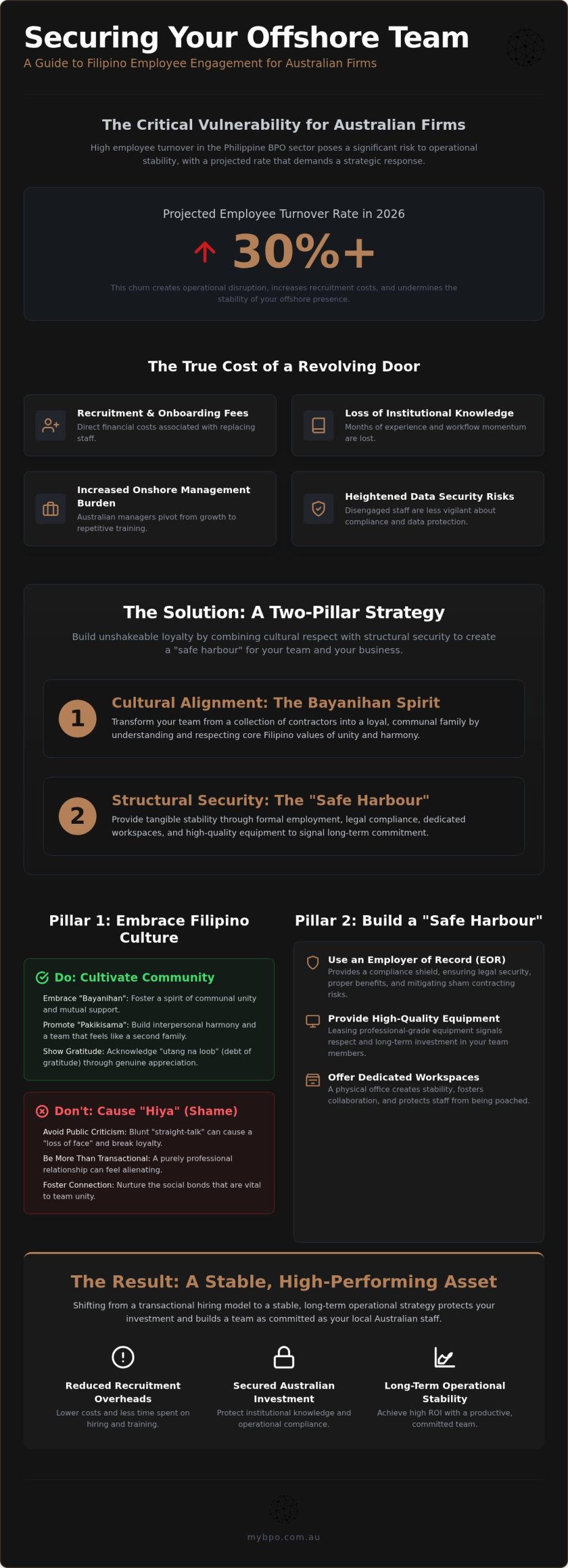
Did you know that the employee turnover rate in the Philippine BPO sector is projected to exceed 30% in 2026? This figure represents a critical vulnerability for Australian firms relying on offshore talent to scale their operations. You’ve likely experienced the operational disruption caused when a key staff member departs for a marginal salary increase elsewhere. It’s a common challenge, yet many managers fail to realise that effective filipino employee engagement strategies require more than just competitive pay; they require a foundation of structural security and cultural alignment.
You deserve a team that is as committed to your business as your local Australian staff. This article demonstrates how to build that loyalty by aligning your management style with Filipino cultural values and the legal protections of a formal Employer of Record structure. We’ll explore how providing a “safe harbour” through local compliance and dedicated physical workspaces creates the stability necessary for high performance. You’ll learn how to mitigate turnover risks and secure a productive, long-term offshore presence that protects your investment and reduces recruitment costs.
Key Takeaways
- Understand the “Bayanihan” spirit to transform your offshore presence from a collection of contractors into a loyal, communal family unit.
- Recognise that high-quality equipment leasing and dedicated workspaces are essential signals of respect that mitigate the risk of staff poaching.
- Adopt an Employer of Record (EOR) structure to serve as a compliance shield, providing the legal security that is central to effective filipino employee engagement strategies.
- Implement a structured communication framework that balances Australian professional standards with the cultural necessity for social connection and communal unity.
- Secure your Australian investment by shifting from a transactional hiring model to a stable, long-term operational strategy that minimises recruitment overheads.
Why Filipino Employee Engagement Strategies Matter for Australian Firms
In the competitive 2026 Philippine BPO landscape, engagement isn’t a “soft” HR luxury; it’s a strategic shield. Disengaged staff represent a massive flight risk in an economy where skilled professionals are in high demand. If your team feels disconnected from your Australian head office, they’re likely already looking at the next offer. This churn isn’t just an HR headache. It creates friction in communication and heightens operational risks for your business. Implementing robust filipino employee engagement strategies ensures your offshore team remains a stable, high-performing asset rather than a revolving door of contractors.
The High Cost of Disengagement
Replacing an offshore specialist involves more than just a new recruitment fee. You lose months of institutional knowledge and momentum. In a remote setting, disengagement often manifests as “quiet quitting” or, worse, security lapses. When a worker isn’t invested in your firm, they’re less vigilant about data protection and Australian compliance standards. The hidden costs of disengagement include:
- Direct recruitment and onboarding fees for replacement staff.
- Loss of institutional knowledge and workflow momentum.
- Increased management burden on your local Australian staff.
- Heightened risks to data security and operational compliance.
The disruption to your local Australian team cannot be ignored. Every time an offshore staff member leaves, your onshore managers must pivot from strategic growth to basic training. This diversion of resources is a hidden tax on your Australian productivity. With salary increase budgets projected at a median of 5.5% for 2026, retention is your most cost-effective growth strategy.
Engagement as a Compliance Tool
A strong relationship is your best defence against “moonlighting” or multiple-jobbing, which remains a prevalent risk in the digital freelance market. By aligning your business with fundamental Filipino values such as utang na loob (debt of gratitude) and pakikisama (interpersonal harmony), you build a bond that transcends a simple transaction. This deep connection significantly reduces the sham contracting Philippines risk, as workers are more likely to value the security and benefits of a formal employment structure over the instability of freelance work.
Successful engagement creates a “safe harbour” for your business operations. When staff feel secure and respected, they provide the long-term stability required for a high ROI. This stability allows you to focus on scaling your Australian operations without the constant threat of talent attrition. Ultimately, engagement is a risk-mitigation strategy that secures your cross-border operations against legal and operational vulnerabilities.
The Cultural Core: Bayanihan and the Filipino Work Ethic
Understanding the cultural engine of your offshore team is a prerequisite for operational stability. In the Philippines, the concept of “Bayanihan” represents communal unity and mutual support. It’s the spirit of a community moving a house on their shoulders to help a neighbour. When applied to a business context, your Philippine staff don’t just see a workplace; they see a community. If an Australian manager treats the relationship as purely transactional, they risk alienating the team and triggering high turnover. Successful filipino employee engagement strategies pivot on this sense of shared identity and communal purpose.
Family is the primary social unit in the Philippines, and this loyalty often extends to the office. Your team frequently views their colleagues as a second family. This bond is a powerful asset if managed correctly, but it also introduces the concept of “Hiya” or shame. If a manager provides blunt, public criticism in the typical Australian “straight-talk” fashion, it can cause a devastating “loss of face”. This doesn’t just hurt feelings; it breaks the psychological contract of loyalty, often leading to immediate disengagement or resignation. Bridging the gap between the Australian “Fair Go” and Filipino communal values requires a nuanced, protective management style.
Fostering a Sense of Belonging
Integrating remote staff into your Australian “on-shore” culture requires a structured approach that respects their local identity to mitigate the risk of cultural friction. This requires more than a Slack channel. Implementing “Kamustahan” sessions, which are informal check-ins focused on wellbeing rather than task lists, is essential. These sessions allow managers to navigate the emotional landscape of their team before issues escalate. Additionally, acknowledging local Philippine holidays is a critical signal of respect. If you ignore significant dates in Manila and Bacolod, you signal that their culture is secondary to your operations, which undermines long-term commitment.
Communication Styles: Direct vs. Indirect
Australian managers are famously direct, which often clashes with the traditional Filipino preference for indirect communication to maintain harmony. You might ask if a deadline will be met and receive a “yes” that actually means “I’ll try, but there are obstacles I don’t want to bother you with.” To mitigate this risk, you must become an “approachable authority figure”. Encourage open dialogue by asking open-ended questions and rewarding the reporting of challenges early. This approach reduces the liability of hidden project delays and secures your workflow. If you need assistance in bridging these cultural gaps, our local specialists provide the on-the-ground guidance necessary to maintain a cohesive cross-border culture.
Structural Engagement: Beyond Digital Platforms to Physical Support
Reliable infrastructure is the silent foundation of any successful offshore operation. While digital collaboration tools are necessary, they cannot resolve the fundamental physical challenges of working in the Philippines, such as intermittent power supply and fluctuating internet speeds. To secure your investment, you must provide a stable environment that allows your team to perform without technical friction. This structural approach is a cornerstone of effective filipino employee engagement strategies, as it demonstrates a tangible commitment to the staff member’s professional success. If your team is constantly fighting with slow connections or blackouts, their engagement will inevitably erode, leading to frustration and eventually turnover.
The Impact of Professional Infrastructure
Working from a kitchen table or a shared living space introduces constant distractions and operational risks that can undermine even the most skilled professional. Providing a dedicated workspace Philippines ensures your staff can focus in a professional, climate-controlled environment with redundant power and high-speed connectivity. This isn’t merely a perk; it’s a signal of respect. When you invest in high-quality equipment leasing, you’re giving your team the proper tools for their trade, which significantly boosts morale.
Professional equipment also serves as a protective measure for your Australian firm. A high-spec laptop provided by the company is easier to secure and monitor than a personal device. This physical security directly supports your data protection protocols, reducing the risk of breaches. By moving your team into a managed office environment, you’re absorbing the operational risks of local infrastructure, allowing your staff to feel a sense of professional pride and operational freedom. This environment fosters a “safe harbour” where productivity is the default, not a struggle against local conditions.
On-the-Ground Representation
Digital management platforms often fail to capture the nuances of local workplace grievances or the subtle shifts in team morale. Having a physical, Australian-managed presence in Manila or Bacolod provides a safety net that software cannot replicate. Local HR specialists can resolve interpersonal issues or administrative concerns before they escalate to your Australian head office. This human presence is vital for building trust, as it shows your team that they aren’t just names on a spreadsheet, but valued members of a global organisation with local support.
Local support is also essential for navigating the complexities of average pay in the Philippines and managing benefits expectations in a competitive market. When your staff know there’s a local ally they can speak with in person, their trust in your organisation deepens. This physical bridge between Australia and the Philippines mitigates the “out of sight, out of mind” risk that often plagues remote teams. It ensures that your filipino employee engagement strategies are grounded in the physical reality of your team’s daily lives, securing long-term loyalty through tangible support and accountability.
A Step-by-Step Engagement Framework for Australian Managers
Moving from a transactional relationship to a partnership requires a methodical approach. Effective filipino employee engagement strategies are built on a framework that balances Australian operational standards with Philippine cultural nuances. If you fail to provide a clear structure, you invite the risk of staff drift and eventual attrition. Follow these five steps to secure your team’s commitment:
- Step 1: Cultural Orientation. Conduct a formal orientation for both your Australian managers and Philippine staff. This removes assumptions and establishes a shared vocabulary for feedback.
- Step 2: Communication Rhythm. Establish a predictable schedule of meetings. Include dedicated “non-work” social time to foster the communal unity that is essential for a productive Philippine workplace.
- Step 3: Culturally Appropriate Recognition. Use public praise to build morale, but ensure feedback is delivered privately to avoid “loss of face”.
- Step 4: Career Pathways. Clearly define how a staff member can progress within your firm. Ambition is a significant driver in the Manila and Bacolod talent markets.
- Step 5: Regularise Employment. Secure your team’s future by using a professional employer of record Australia model to provide full legal benefits and security of tenure.
Recognition and Reward Systems
Rewarding your team in the Philippines requires more than just an occasional bonus. While the 13th-month pay is a mandatory legal requirement, it’s viewed as the absolute baseline for engagement. To truly differentiate your firm, you should implement rewards that resonate with the employee’s family life. Providing health insurance extensions for parents or grocery vouchers for family celebrations creates a debt of gratitude that salary alone cannot buy. Public recognition, such as “Employee of the Month” awards, carries significant weight in a culture that values communal standing and peer respect.
Career Pathing and Upskilling
Filipino professionals are famously ambitious and highly value the opportunity to acquire new skills. With salary increase budgets in the Philippines projected at a median of 5.5% for 2026, you must offer more than just financial increments to remain competitive. Investing in professional development serves as a form of “loyalty currency”. When you provide training in Australian business practices or specific technical certifications, you’re signalling that the staff member has a long-term future in your organisation. This learning culture is a core foundation of your filipino employee engagement strategies, ensuring that your team feels valued as long-term partners rather than temporary resources.
If you are ready to secure your offshore team and reduce turnover, contact our Australian-led team today to discuss a tailored EOR solution that protects your business.
Managing Remote Teams in the Philippines via an EOR Compliance Shield
The most effective filipino employee engagement strategies fail if they are built on a foundation of financial or legal instability. For a Filipino professional, true engagement is inseparable from the security of their employment status. An Employer of Record (EOR) model serves as the gold standard for engagement because it provides the worker with absolute “peace of mind”. When a staff member is legally regularised, they’re no longer a precarious “independent contractor” but a protected employee with full rights under the Department of Labor and Employment (DOLE) guidelines. This structural security is a powerful motivator that ensures your team remains focused on your business goals rather than searching for more stable opportunities.
Reliability in compensation is the bedrock of trust in any cross-border relationship. Utilising a professional system for payroll Philippines for Australian companies ensures that payments are accurate, compliant, and delivered every fortnight without fail. This consistency mitigates the anxiety often associated with international transfers and currency fluctuations. Beyond the logistics, MyBPO acts as a “cultural translator”. We bridge the gap between your Australian management expectations and the local workforce’s needs, ensuring that communication remains clear and friction-free. We absorb the operational risks and administrative burdens, allowing you to function as a leader while we act as your vigilant guardian on the ground.
The Psychological Safety of Legal Employment
In the Philippine market, being a “regular” employee is a significant status symbol and a primary driver of long-term loyalty. This status grants access to essential statutory benefits, including the Social Security System (SSS), PhilHealth, and the Home Development Mutual Fund (Pag-IBIG). Contrast this with the constant anxiety of “freelance” contracting, where workers must navigate their own taxes and lack a safety net. By providing these benefits through an EOR, you’re investing in the employee’s family and future. MyBPO secures the employee’s legal standing and financial future, which in turn secures the long-term stability of your Australian team.
Scaling with Confidence
A structured engagement strategy is what allows an Australian firm to scale from a single virtual assistant to a dedicated, multi-role department. As your offshore presence grows, maintaining a cohesive company culture becomes increasingly complex. MyBPO ensures that your values are upheld in Manila and Bacolod, regardless of the size of your team. We provide the physical infrastructure and local HR oversight necessary to maintain high morale and productivity during periods of rapid growth. This partnership allows you to expand your operations with the confidence that your team is protected by a robust compliance shield. If you’re ready to build a loyal, high-performing offshore department, secure your Philippine team’s future with MyBPO today.
Securing Your Offshore Future through Structural Alignment
Building a high-performing Philippine team requires a fundamental shift from transactional management to a model of structural and cultural alignment. You’ve seen how the spirit of Bayanihan and the provision of professional workspaces serve as the bedrock for long-term loyalty. By moving beyond digital tools to provide tangible physical support and legal security, you mitigate the risks of turnover and operational friction. Implementing these filipino employee engagement strategies ensures your business isn’t just surviving in the competitive 2026 market but actively thriving through a stable, dedicated workforce.
MyBPO stands as your Australian-owned specialist in the AU-PH employment corridor, providing the physical infrastructure and regulatory expertise you need to succeed. With physical offices in Manila and Bacolod, we act as your vigilant guardian on the ground, ensuring total compliance while you focus on scaling your operations. Don’t leave your offshore investment to chance. Build a secure, engaged Philippine team with MyBPO’s EOR services and experience the operational freedom that comes with a protected, loyal team. We look forward to helping you bridge the gap between your Australian goals and Philippine success.
Frequently Asked Questions
What are the most effective Filipino employee engagement strategies for remote teams?
Effective filipino employee engagement strategies focus on building communal unity and providing structural security through formal employment. Australian managers should prioritise regular “Kamustahan” check-ins and provide high-quality equipment to signal professional respect. When staff feel their local legal rights are protected and they have the tools to succeed, their commitment to the Australian head office deepens significantly. This dual approach of cultural empathy and operational excellence is the most reliable path to high performance.
How does the Filipino concept of Bayanihan apply to a modern office environment?
In a modern office, Bayanihan manifests as a collaborative work ethic where team members prioritise group success over individual accolades. This communal spirit means your Philippine staff will often go above and beyond to support a colleague in need to ensure a project’s completion. Managers can harness this by setting team-based goals and fostering a family-like atmosphere. If you encourage this unity, you create a self-sustaining support network that reduces the management burden on your Australian onshore team.
Is salary the only thing that matters to offshore staff in the Philippines?
Salary is a baseline requirement, but it is rarely the sole driver of long-term loyalty in the Philippine market. While competitive pay is necessary to attract talent, retention is driven by factors such as career growth, work-life balance, and the quality of the physical workspace. Employees often prioritise the security of mandatory benefits and a supportive company culture over a slightly higher freelance rate. Providing a “safe harbour” through legal employment and professional development is what truly secures your workforce.
How can I prevent high staff turnover in my Philippine offshore team?
Preventing high turnover requires moving away from transactional contracting toward a regularised employment model. You should implement structured filipino employee engagement strategies that include clear career pathing and family-centric rewards. High turnover often stems from a lack of perceived stability or a disconnect from the Australian head office. By providing a dedicated workspace and local HR support, you create a sense of belonging that makes it difficult for competitors to poach your staff.
Does a 13th-month pay help with employee engagement and retention?
The 13th-month pay is a mandatory legal requirement in the Philippines and serves as a fundamental baseline for trust. While its payment is expected by law, it significantly aids retention by providing financial security for the employee’s family during the Christmas season. If an Australian firm fails to manage this compliance correctly, it causes immediate disengagement and legal liability. However, to truly drive engagement, you must supplement this mandatory payment with non-monetary recognition and professional respect.
How do I provide feedback to a Filipino employee without causing “loss of face”?
Providing feedback requires a private and constructive approach to avoid “Hiya” or public shame. You should deliver critiques one-on-one and frame them as opportunities for communal growth rather than individual failure. Start with positive reinforcement to maintain harmony before addressing specific areas for improvement. If you maintain an “approachable authority” persona, your staff will feel safe enough to accept guidance without feeling their professional dignity has been compromised in front of their peers.
Can an Employer of Record (EOR) help improve my teams engagement levels?
An Employer of Record (EOR) directly improves engagement by providing the worker with the psychological safety of “regular” employment. MyBPO ensures that staff receive all statutory benefits, such as SSS and PhilHealth, which are critical for their family’s security. This formal structure transforms a precarious remote gig into a stable career. When an employee knows their legal rights are secured by a local entity, they are far more likely to invest their long-term future in your business.
How do I manage the cultural differences between Australian and Filipino workers?
Managing these differences requires a structured cultural orientation for both your Australian and Philippine teams to bridge the gap between direct and indirect communication styles. You must learn to interpret the nuances of Filipino politeness while teaching your team to navigate the Australian “straight-talk” culture. Establishing a predictable rhythm of communication that includes social time helps build the necessary trust. This bridge-building allows both sides to function as a single, cohesive unit despite the geographical and cultural distance. A key element of this stability is also ensuring your staff receive consistent wages unaffected by market shifts; understanding how to approach managing exchange rate risk in Employer of Record arrangements is an essential part of protecting both your team’s morale and your operational budget.
Need a strategy session?
Tell us about your team and we will map out the right structure, fixed-cost quote included.
Book a call