Blog
Common Offshoring Mistakes to Avoid: The 2026 Compliance Checklist for Australian Firms

The cheapest labour rate in the Philippines is often the most expensive mistake an Australian director can make. While the promise of reduced overheads is tempting, a budget-first approach frequently leads to poor output quality and severe regulatory exposure. You likely recognise that scaling requires offshore talent, yet the fear of a $495,000 Fair Work penalty for sham contracting remains a significant barrier to entry. It’s frustrating to manage freelancers who don’t understand your business culture or to feel lost in the complexity of Philippine mandatory benefits.
This guide outlines the common offshoring mistakes to avoid to ensure your organisation stays on the right side of the law. You’ll learn how to master the structural and legal nuances of the Australia-Philippines corridor to build a secure, high-performing team without the regulatory headaches. We provide a clear roadmap to achieving a legally bulletproof offshore structure that delivers operational savings without compromising compliance. We’ll preview the 2026 compliance checklist, covering everything from Payday Super reforms to the substance over form test, positioning your offshore operation as a protected, professional extension of your Australian team.
Key Takeaways
- Understand how to navigate the latest Fair Work amendments to ensure your offshore structure is legally sound and immune to sham contracting penalties.
- Identify and bypass the most common offshoring mistakes to avoid by shifting from a “bargain hunting” mindset to a strategic asset model.
- Protect your intellectual property and data integrity by moving beyond unmanaged work-from-home setups to secure, hardware-standardised environments.
- Bridge the cultural gap between Australia and the Philippines by fostering psychological safety and moving past the “Yes” culture to ensure clear communication.
- Learn how an Australian-owned Employer of Record (EOR) acts as a compliance shield, absorbing the legal and operational liabilities of international employment.
Rethinking the “Cheap Labour” Mindset: Why Most Australian Offshoring Projects Fail
Australian directors often view the Philippines as a digital marketplace for low-cost tasks rather than a sophisticated labour market. This fundamental misapprehension is why many initiatives fail within the first twelve months. If you treat offshore staff as a commodity, you invite the very risks you seek to avoid. A transactional approach ignores the definition of offshoring as a strategic relocation of business processes, reducing it instead to a desperate cost-cutting exercise. When personnel are viewed as replaceable line items, the structural integrity of the entire operation is compromised.
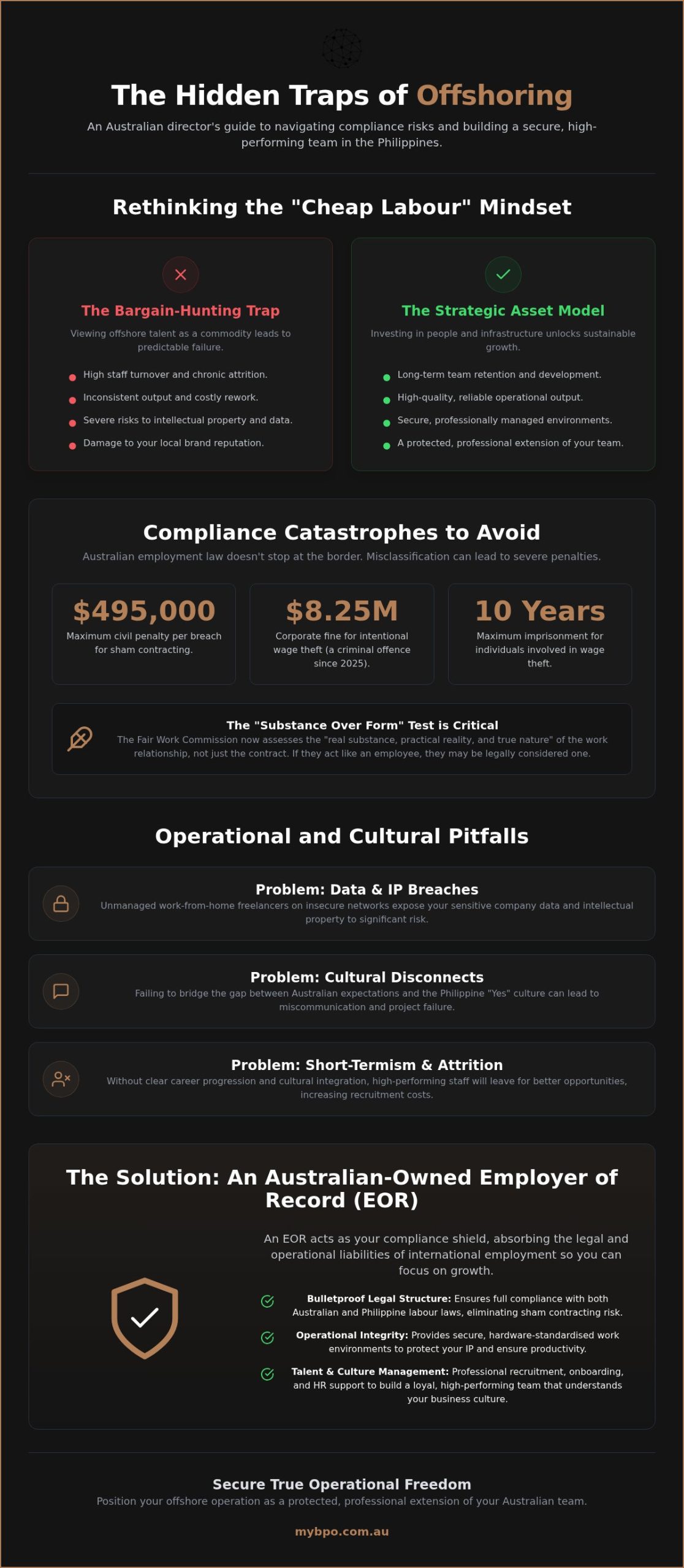
One of the most common offshoring mistakes to avoid is “bargain hunting” for unmanaged freelancers on anonymous digital platforms. While the initial quote looks attractive, the hidden costs are substantial. You’ll likely face high staff turnover, inconsistent output, and significant risks to your intellectual property. Without a secure, physical infrastructure and a local presence to manage accountability, your sensitive data is essentially unprotected. The cost of one significant IP breach or a failed project far outweighs any perceived savings from a cut-price hourly rate.
The Quality-Cost Paradox
The lowest hourly rate usually results in the highest total cost of ownership. If an Australian firm hires based on price alone, it often inherits a massive management burden. Rework and poor vetting of candidates for client-facing roles can damage your local brand reputation and alienate your domestic customers. We define strategic offshoring as an investment in scalable infrastructure and human capital, not merely a line-item saving on the balance sheet. It requires professional recruitment services to ensure candidates possess the technical proficiency and cultural alignment necessary for Australian business standards.
Short-Termism vs. Sustainable Scaling
Firms that fail to plan for the career progression of their Philippine team often suffer from chronic attrition. If your offshore staff feel like temporary help rather than valued professionals, they won’t invest in your long-term goals. Sustainable scaling requires the Australian onshore team to buy into the integration process from the outset. You must view the Philippines as a high-tier talent hub rather than a discount bin for menial tasks. If you don’t provide a clear path for growth and include staff in your company culture, you’ll struggle to retain the high-performers who drive real operational value. Treating your offshore office as a protected extension of your Australian headquarters is the only way to secure true operational freedom.
Compliance Catastrophes: Avoiding Sham Contracting and Fair Work Risks
One of the most dangerous common offshoring mistakes to avoid is the assumption that Australian employment law stops at the border. The Fair Work Legislation Amendment (Closing Loopholes No. 2) Act 2024 fundamentally altered the legal landscape by shifting the test for employment status from “contract primacy” to the “real substance, practical reality, and true nature” of the relationship. If your offshore worker performs duties like an employee—following your directions, using your tools, and working set hours—the Fair Work Commission may deem them an employee regardless of what your written contract says. This “substance over form” approach means your legal exposure is determined by how the work is actually done, not by the labels you use.
Failing to recognise this reality exposes Australian directors to severe personal and corporate liabilities. Under current regulations, a serious contravention of sham contracting provisions carries a maximum civil penalty of $495,000 for a company per breach. Since January 1, 2025, intentional wage theft has also been a criminal offence, with fines reaching up to $8.25 million for corporations or ten years’ imprisonment for individuals. You cannot simply “contract out” of these obligations by paying an invoice to a foreign bank account or a PayPal address. If the acceptance of an employment offer is received in Australia, that worker may fall under the protection of Australian law, including unfair dismissal provisions.
The Sham Contracting Trap
Many firms believe that paying a Philippine worker as an “independent contractor” via digital payment platforms provides a legal buffer. It doesn’t. If the relationship is found to be one of employment, you are liable for back-paying years of leave entitlements and the mandatory 13th-month pay. This financial risk is why we recommend Exposing the Sham Contracting Philippines Risk to understand how the Fair Work Ombudsman identifies non-compliant structures. To mitigate this, an Australian-owned EOR can absorb these employment liabilities on your behalf, acting as a “compliance shield” for your business.
Navigating Philippine Labour Code (DOLE)
Compliance isn’t just about Australian law; you must also satisfy the Philippine Department of Labour and Employment (DOLE). Missing mandatory contributions to SSS, PhilHealth, and Pag-IBIG is a common pitfall that triggers local legal action. The Philippines also operates under a strict “Security of Tenure” principle. This means you cannot terminate staff without just or authorised cause, a concept far more rigid than many Australian directors expect. For a detailed breakdown of these obligations, consult our guide on Payroll in the Philippines for Australian Companies. Ignoring these local standards often results in expensive litigation that drains the cost benefits of your offshore operation.
Operational Pitfalls: The Checklist for Structural Integrity
Operational resilience is the silent partner of legal compliance. While previous sections focused on the Fair Work Act, the physical reality of the Philippines presents its own set of unique challenges. One of the most common offshoring mistakes to avoid is the assumption that a laptop and a home internet connection constitute a professional office. In many Philippine regions, residential infrastructure is prone to frequent power outages and unstable bandwidth. Relying on these unmanaged environments exposes your firm to significant downtime and data security vulnerabilities. A “Compliance Shield” isn’t just a legal concept; it’s a physical one that requires enterprise-grade facilities to protect your operational continuity.
Physical vs. Virtual Infrastructure
Establishing a Dedicated Workspace Philippines is the only way to guarantee structural integrity. A secure offshore workspace must include a specific checklist: enterprise-grade backup power (UPS and generators), redundant fibre-optic internet connections, and strict physical access controls. We also advise against “Bring Your Own Device” (BYOD) policies, which are often a gateway for IP theft and malware. Equipment leasing through an Australian-owned EOR ensures that all hardware meets your specific data encryption and security standards. This physical presence protects your sensitive data from the vulnerabilities of an unmanaged home office while providing a professional centre for your team to thrive.
Standard Operating Procedures (SOPs)
Operational failure often stems from the mistake of assuming “common sense” is universal. Standard Operating Procedures (SOPs) must be meticulously documented to bridge the gap between Australian expectations and Philippine execution. If a process isn’t written down, it doesn’t exist in an offshore context. You must provide clear, step-by-step workflows that ensure consistency across both your AU and PH teams. Having on-the-ground support in Manila or Bacolod allows for the real-time enforcement of these standards. This local oversight transforms your offshore staff from isolated contractors into a high-performing unit that operates with the same professional gravity as your local team. Without these documented safeguards, you risk high turnover and a constant cycle of rework that drains your operational savings.
Cultural Disconnects: Managing a Philippine Team with Australian Expectations
The success of an offshore operation often hinges on the invisible nuances of cross-cultural communication. Australian business culture is fundamentally egalitarian and direct, whereas the Philippines operates within a high power distance framework where hierarchy is deeply respected. One of the most common offshoring mistakes to avoid is mistaking “polite agreement” for actual comprehension. This “Yes culture” is often a face-saving mechanism. If an offshore staff member feels that saying “I don’t understand” will cause them or their manager to lose face, they may proceed with a task incorrectly, leading to expensive rework and project delays.
Failing to establish psychological safety is a critical operational risk. If your Philippine team doesn’t feel secure enough to flag errors or suggest improvements, you lose the primary benefit of their expertise. Australian directness, while efficient in a domestic context, is frequently perceived as aggression in the Philippines. This perceived hostility can cause staff to withdraw, further stifling communication. You must consciously adapt your management style to be supportive and encouraging, ensuring that your team feels like a protected extension of your Australian headquarters rather than a detached service provider. Excluding offshore staff from the broader company culture and social events only reinforces this sense of isolation, which is a leading cause of high attrition.
Bridging the Communication Gap
Closing the loop in virtual communication requires a methodical approach. You should never assume an instruction is understood until the staff member can explain the task back to you in their own words. Video-first meetings are a non-negotiable requirement for building trust and reading non-verbal cues that text-based communication misses. By fostering a culture of proactive problem-solving, you transition your team from passive task-takers to strategic assets. This transition is only possible when you include offshore staff in your internal communications and treat them with the same professional gravity as your local team.
Reward and Recognition
Retention is driven by more than just a competitive salary; it requires an understanding of local mandatory benefits and cultural values. The 13th-month pay is a statutory requirement in the Philippines that must be paid by December 24th each year. Additionally, providing private health insurance (HMO) is a standard expectation for professional roles. Ignoring these cultural and legal benchmarks, or failing to account for Philippine public holidays in your AU workflows, will lead to resentment and turnover. To secure high-performing talent and drive long-term engagement, you must partner with an Australian-owned EOR that understands how to navigate these local expectations while protecting your business interests.
Securing the Future: How an Australian-Owned EOR Mitigates Every Risk
Navigating the 2026 compliance landscape requires more than just a legal checklist; it demands a robust structural partner. For an Australian director, the most effective way to eliminate common offshoring mistakes to avoid is to utilise an Australian-owned Employer of Record (EOR). This model provides a “safe harbour” by placing a domestic legal entity between your business and the complexities of foreign labour codes. By engaging with a partner that maintains physical representation in both Australia and the Philippines, you ensure that your offshore operations are governed by Australian professional standards and Philippine statutory requirements simultaneously. MyBPO maintains a human presence in Manila and Bacolod to absorb the legal and operational risks of Philippine employment, effectively insulating your firm from the liabilities discussed in previous sections.
The MyBPO Advantage
MyBPO streamlines the expansion process by consolidating recruitment, payroll, and compliance under one Australian contract. This eliminates the need for you to manage multiple foreign vendors or navigate unfamiliar tax systems. We provide the security of Australian-managed infrastructure through our equipment leasing and dedicated workspaces, ensuring your data is never left to the vulnerabilities of unmanaged home environments. For a comprehensive look at how this structure protects your business, refer to our Employer of Record Australia: The Definitive Guide. This integrated service model ensures that every staff member is a high-performing professional who feels like a genuine part of your Australian team. You gain operational freedom when your offshore office operates with the same professional gravity as your local headquarters.
Your Next Steps to a Secure Team
Transitioning from a high-risk contractor model to a managed EOR is a critical step in global scaling success. You should begin by auditing your current offshore arrangement for compliance gaps, specifically looking for indicators of sham contracting or missing mandatory benefits. If your current structure relies on direct payments to individuals, you are likely carrying a significant liability load. We define the MyBPO EOR as a “Compliance Shield” that allows AU firms to focus on growth, not paperwork. Once your risks are mitigated, you can scale with the confidence that your intellectual property is secure and your employment practices are legally bulletproof. Moving beyond the era of offshoring mistakes allows you to build a resilient, international workforce that drives genuine operational cost savings without compromising on quality or compliance.
Building a Protected Path to International Growth
Successful offshoring in 2026 requires a transition from transactional cost-cutting to strategic, structural integrity. We’ve identified that the common offshoring mistakes to avoid centre on regulatory negligence and unmanaged infrastructure. By prioritising the “substance over form” test in your employment contracts and securing dedicated, office-based workspaces, you protect your firm from catastrophic Fair Work penalties and data breaches. These safeguards are essential for maintaining a high-performing team that delivers consistent value.
MyBPO serves as your local compliance specialist, providing a secure bridge between Australian standards and Philippine operations. As an Australian-owned and operated entity with a physical presence in Australia, Manila, and Bacolod, we maintain a human presence on the ground. This ensures your team is managed under a framework that aligns perfectly with both the Fair Work Act and the Philippine Labour Code. This structural protection allows you to absorb employment liabilities while focusing on your core business objectives.
Secure your offshore team with MyBPO’s Australian-owned EOR services today.
Take the first step toward a high-performing, compliant global team that feels like a natural extension of your Australian headquarters.
Frequently Asked Questions
What is the biggest legal mistake Australian companies make when offshoring?
The biggest legal mistake is misclassifying employees as independent contractors, which is one of the common offshoring mistakes to avoid. This error triggers sham contracting provisions under the Fair Work Act. Australian directors often assume that paying via a digital platform provides a legal buffer; however, the “Closing Loopholes” amendments focus on the practical reality of the work. If the relationship functions like employment, you face significant civil penalties regardless of the written agreement.
Does the Australian Fair Work Act apply to staff in the Philippines?
Yes, the Fair Work Act 2009 can apply to offshore workers if the employment contract is formed in Australia. A key determinant is where the acceptance of the employment offer is received. If you are an Australian company and the contract is finalised here, the staff member may be considered “Australian-based.” This grants them protections under Australian law, including access to unfair dismissal claims and the national minimum wage standards.
Is it better to hire a Philippine freelancer or use an EOR?
Using an Employer of Record is significantly safer than hiring a freelancer for long-term roles. Freelancers operate without managed security or local legal oversight, which is one of the common offshoring mistakes to avoid. An EOR provides a “compliance shield” by absorbing employer liabilities and ensuring local labour laws are met. While freelancers seem cheaper initially, the lack of structural integrity and legal protection creates a vulnerable environment for your business.
How do I protect my intellectual property (IP) when offshoring?
Protecting intellectual property requires a combination of Australian-governed contracts and physical infrastructure control. You should avoid “Bring Your Own Device” policies and instead utilise equipment leasing through a managed provider. This allows for hardware-level data encryption and secure network protocols. Combining these technical measures with a physical, dedicated workspace ensures that your data remains within a controlled environment, significantly reducing the risk of unauthorised access or IP theft.
What are the mandatory benefits I must pay a Philippine employee?
Philippine labour law requires several mandatory contributions that Australian firms must facilitate to remain compliant. These include Social Security System (SSS), PhilHealth for medical insurance, and Pag-IBIG for housing funds. You are also required to pay the 13th-month salary and provide service incentive leave. Failing to manage these contributions correctly can lead to litigation with the Department of Labour and Employment (DOLE), which undermines the financial benefits of your offshore strategy.
Can I be fined for sham contracting if my offshore staff are in the Philippines?
You can be fined for sham contracting even if your staff are based in the Philippines. For a serious contravention, the maximum civil penalty is $495,000 for a company and $99,000 for an individual per breach. The Fair Work Ombudsman uses data matching and tip-offs to identify firms that misclassify workers to avoid tax and superannuation obligations. These penalties are designed to be punitive and can be financially devastating for Australian directors.
How much does it cost to set up a compliant offshore team compared to a freelancer?
Setting up a compliant offshore team through an EOR involves higher initial administrative costs than hiring a freelancer, but it reduces the total cost of ownership. Freelancers often have hidden costs related to high turnover, rework, and potential legal penalties. A managed model includes recruitment services and dedicated workspaces, which provide the stability needed for scaling. Investing in a compliant structure protects you from the massive fines associated with wage theft and sham contracting.
What is the “13th-month pay” and is it optional for Australian employers?
The 13th-month pay is a mandatory statutory benefit in the Philippines and is not optional for Australian employers. It consists of one-twelfth of the basic salary earned by an employee within a calendar year and must be paid by the 24th of December. This is a non-negotiable requirement under Philippine law. Neglecting this payment is a common trigger for local labour disputes, which can disrupt your operations and damage your reputation as a global employer.
Need a strategy session?
Tell us about your team and we will map out the right structure, fixed-cost quote included.
Book a call