Blog
Philippines Entity Setup: A Guide for Australian Firms

The dream of total operational control through a local subsidiary often masks a harsh financial reality: a $200,000 USD capital lock-up that most Australian SMEs simply don’t need to bear. You’ve likely heard that setting up a local entity in the philippines is the only way to truly “own” your offshore team. It’s a logical assumption, but it often overlooks the opaque bureaucratic hurdles, the constant pressure of DOLE compliance, and the significant weight of local administrative liability. If you aren’t prepared for the complexities of the Philippine legal system, your expansion can quickly turn from a growth opportunity into a compliance nightmare.
We recognise that your primary goal is to secure your business while scaling efficiently. This guide will help you navigate the labyrinth of Philippine incorporation while revealing why an Employer of Record (EOR) model often provides a far superior security framework for Australian firms. We’ll provide a clear breakdown of actual incorporation costs, compare the subsidiary model against the EOR alternative, and outline a risk-mitigation strategy that protects your interests. By the end of this article, you’ll have a structured path forward that balances operational control with total regulatory safety.
Key Takeaways
- Understand the financial impact of the USD 200,000 paid-in capital requirement and how it affects your liquidity during international expansion.
- Identify the administrative complexities involved in setting up a local entity in the philippines, including the ongoing “tail” of BIR and DOLE reporting.
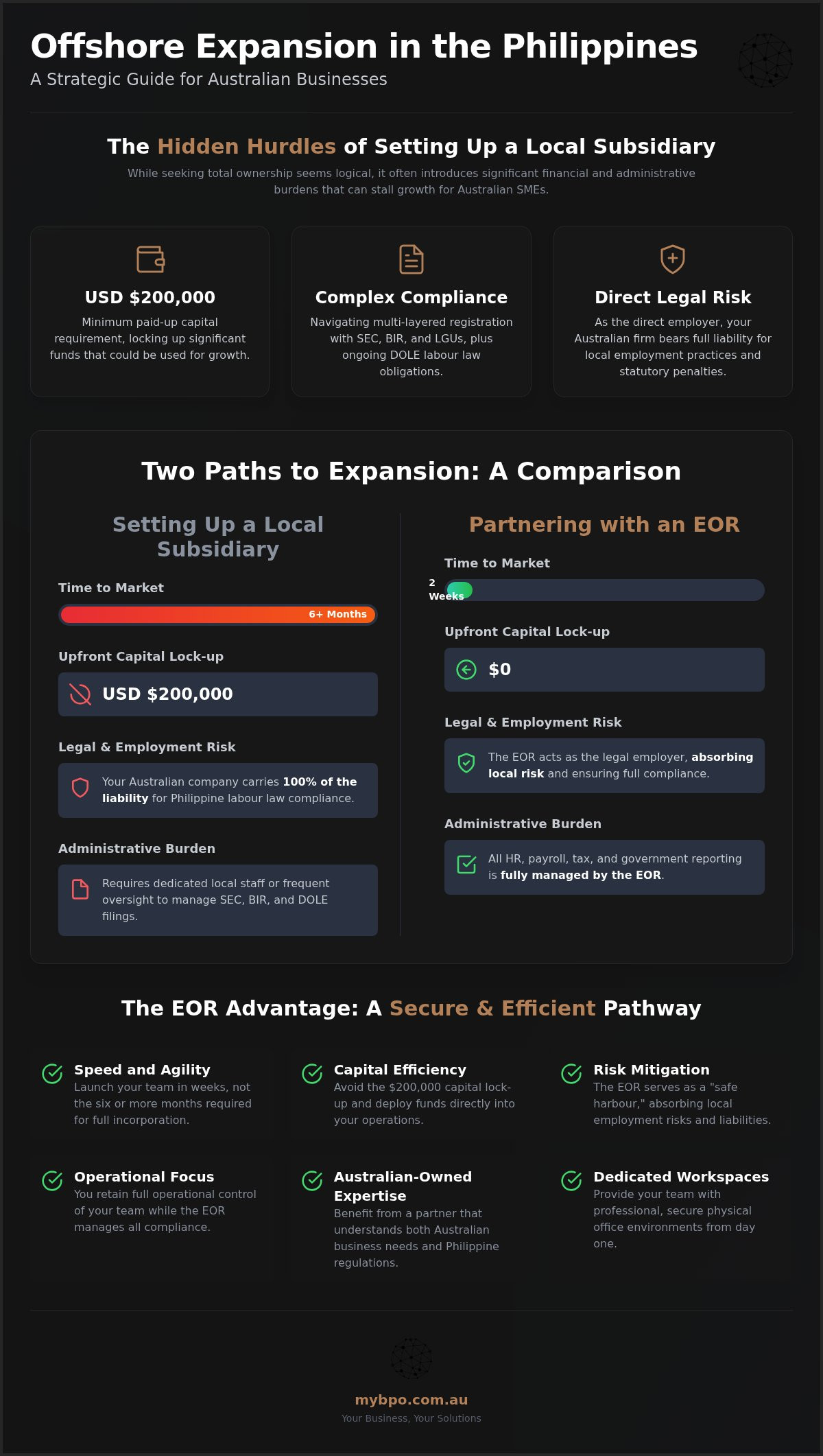
- Evaluate the strategic advantages of an EOR model, which offers a two-week speed-to-market compared to the six-month timeline of full incorporation.
- Learn how an Australian-owned specialist provides a “safe harbour” for your operations by absorbing local employment risks and providing dedicated physical workspaces.
The Reality of Establishing a Philippine Subsidiary for Australian Firms
The natural instinct for many Australian business owners is to seek total ownership of their offshore operations. They believe that by setting up a local entity in the philippines, they can bypass third-party intermediaries and establish a direct culture with their team. While this sentiment is understandable, it often ignores the administrative weight of managing a separate legal personality in a foreign jurisdiction. A Philippine subsidiary is not merely a branch office; it is a distinct legal entity that carries full liability for its actions, debts, and employment practices within the archipelago.
The Philippine investment climate is governed by a complex set of regulations designed to protect local interests while encouraging specific types of foreign capital. A primary hurdle for Australian firms is the Foreign Investment Negative List (FINL), which restricts foreign ownership in various sectors. If your business activity falls under certain categories, you may be barred from 100% ownership unless you meet substantial capital thresholds, often requiring a minimum of USD 200,000 for retail or service-oriented firms. This creates a significant barrier for SMEs that require agility rather than capital lock-up.
The Bureaucratic Landscape in 2026
While the government has introduced digital initiatives like the SEC’s eSPARC platform, the registration process remains a multi-layered challenge. You must secure a Barangay Clearance, obtain a business permit from the local Mayor’s Office, and register with the Bureau of Internal Revenue (BIR). These steps require a physical presence and an intimate understanding of local government units (LGUs), as each municipality may have its own specific requirements for health permits, fire safety inspections, and sanitary clearances. Without reliable on-the-ground representation, Australian firms often find themselves stuck in a cycle of rejected applications and opaque processing delays that can stretch for months.
Why Control is Often a Misconception
Many directors conflate operational control with legal safety. You might manage your team’s daily tasks, but a local entity forces you to manage Philippine labour law directly. The Department of Labor and Employment (DOLE) maintains strict, pro-employee standards that differ significantly from Fair Work Australia. When setting up a local entity in the philippines, you don’t just gain a team; you gain a complex web of legal obligations that require constant vigilance. For an Australian director, the compliance burden represents a personal exposure to foreign statutory penalties and the continuous requirement to oversee jurisdictional filings that exist outside of Australian corporate governance standards. If you don’t have a dedicated local HR and legal team, you aren’t in control; you’re simply at risk.
Capital Requirements and Regulatory Hurdles: The SEC and FINL Framework
The most significant barrier for Australian firms setting up a local entity in the philippines is the mandatory paid-up capital. For domestic market enterprises where foreign ownership exceeds 40 per cent, the standard minimum is USD 200,000. This is a non-negotiable liquidity requirement that must be deposited into a local bank account before registration can proceed. For an Australian SME, this represents a substantial capital lock-up that could otherwise be used for operational growth or local recruitment.
There are specific pathways to reduce this burden, though they come with their own conditions. The threshold may drop to USD 100,000 if the enterprise employs at least 50 Filipino workers or utilises advanced technology as verified by the relevant authorities. The Philippine Board of Investments oversees many of these incentives, but qualifying for them requires rigorous documentation and ongoing reporting. Repatriating this capital later is equally complex. Exiting the market involves a lengthy winding down process with the SEC and BIR, where proving that all local liabilities are settled is a prerequisite for moving funds back to Australia. If the proper Bangko Sentral ng Pilipinas (BSP) registration wasn’t completed at the time of the initial investment, moving those funds out becomes legally difficult.
Navigating the Foreign Investment Negative List
The Foreign Investment Negative List (FINL) dictates exactly where your firm can legally operate. Certain sectors, such as recruitment and retail trade with capital below specific thresholds, are strictly reserved for Philippine nationals or have capped foreign equity. If your firm provides professional services, you must verify if your specific discipline allows for foreign corporate practice. These restrictions can severely limit your ability to hire and operate freely without a local partner, effectively forcing you into a minority position unless you meet the high-capital criteria required for full ownership. If you prefer to avoid these capital hurdles and start hiring immediately, exploring EOR services provides a far more efficient pathway.
The Incorporation Timeline
Establishing a presence is not a swift process. While local platforms have improved, the typical timeline for foreign entities remains four to six months. This journey starts with name reservation and SEC registration, followed by obtaining a Barangay Clearance and the final Mayor’s Permit. Each step is sequential; you cannot obtain a tax ID until your local permits are in place, and you cannot hire staff legally until the BIR has issued your books of accounts. This extended timeline for setting up a local entity in the philippines often leads to “dead time” where your expansion plans are paused while awaiting government approval.
Beyond the time investment, Australian firms often face hidden costs. Legal fees, local consultancy retainers, and the necessity for directors to sign documents in person can add tens of thousands of dollars to the initial setup. These costs are often unrecoverable if the business model changes or if the bureaucratic delays push your launch date past the point of profitability. Managing this “hidden workload” of BIR, SSS, and PhilHealth administration requires a dedicated local team from day one, even before your first revenue-generating staff member is on board.
Post-Registration Obligations: Navigating BIR, DOLE, and Social Insurances
The administrative “tail” of setting up a local entity in the philippines is where many Australian firms encounter their greatest operational friction. Once the initial registration phase concludes, the focus shifts to maintaining standing with the Bureau of Internal Revenue (BIR). This involves a relentless schedule of monthly and quarterly tax filings, even if the entity has no taxable income for the period. Missing a single deadline can trigger automatic penalties and “open cases” that prevent the renewal of annual business permits. You must also maintain physical books of accounts that are registered and stamped by the BIR, a manual requirement that often surprises digital-first Australian businesses.
Beyond tax, you must manage mandatory social insurance contributions for every staff member. This includes the Social Security System (SSS), PhilHealth, and the Pag-IBIG Fund. As of January 2025, the SSS contribution rate is 15 per cent of the monthly salary credit, with the employer responsible for 10 per cent and the employee for 5 per cent. PhilHealth premiums sit at 5 per cent, shared equally. These payments must be reconciled and remitted monthly, requiring a dedicated payroll and compliance officer to ensure accuracy across your entire workforce. Additionally, the 13th-month pay is a non-negotiable statutory requirement. It must be paid to all rank-and-file employees on or before 24 December each year, representing one-twelfth of their total basic salary earned within the calendar year.
Department of Labor and Employment (DOLE) Vigilance
The Philippine labour code is heavily weighted in favour of the employee, making termination a complex and high-risk process. You cannot dismiss a staff member “at will”; you must prove “just cause” or “authorised cause” while strictly following the twin-notice rule of due process. Failure to adhere to these procedural requirements often leads to expensive illegal dismissal cases at the National Labor Relations Commission (NLRC). To mitigate this, your local entity must maintain a comprehensive Employee Handbook that is fully compliant with local law. Regular DOLE inspections are common. Inspectors will scrutinise your records for compliance with minimum wage, holiday pay, and occupational health and safety standards.
Australian Regulatory Alignment
For Australian directors, managing an offshore entity requires careful alignment with the Fair Work Act and recent “Closing Loopholes” legislation. If your local structure is poorly managed or lacks genuine substance, you face a significant sham contracting Philippines risk. This occurs when workers are treated as independent contractors despite having the functional characteristics of employees. When setting up a local entity in the philippines, you must also ensure your contracts are enforceable across jurisdictional boundaries to protect your intellectual property (IP). If your local entity does not have the correct legal frameworks to assign IP rights back to the Australian parent company, your core business assets may be left vulnerable to local claims. Beyond IP, Australian directors must also consider their obligations under the Privacy Act 1988; managing data security with Philippine EOR staff is a critical compliance dimension that extends your legal accountability directly into the offshore environment.
Entity Setup vs. Employer of Record (EOR): A Strategic Comparison
The decision to commit to setting up a local entity in the philippines is often framed as a choice between “control” and “convenience”. However, for the strategic Australian director, the comparison is actually about risk absorption and capital efficiency. While a full subsidiary offers a permanent footprint, the Employer of Record (EOR) model provides a “safe harbour” that allows you to hire and operate within two weeks, rather than the six months typically required for corporate registration. This speed to market is critical for firms needing to respond to immediate growth opportunities without being sidelined by bureaucratic delays.
Capital requirements represent a significant opportunity cost. By choosing an EOR, you avoid the USD 200,000 paid-in capital lock-up, preserving your liquidity for actual business growth. The EOR acts as the legal employer of your staff, absorbing the entire burden of local compliance, labour law liability, and statutory reporting. This structure shields your Australian firm from direct exposure to the Philippine legal system while maintaining your operational authority over the team’s daily output. It’s a pragmatic bridge that provides the benefits of a local workforce without the structural weight of a foreign corporation.
When Does an Entity Actually Make Sense?
A local subsidiary becomes a viable consideration once your workforce exceeds a specific threshold, typically around 100 to 150 staff members, where the economies of scale might offset the massive administrative overhead. Certain industries also require local licensing that can only be held by a domestic corporation. If your long-term strategy involves selling products or services directly into the Philippine domestic market, rather than just offshore staffing, the legal complexity of setting up a local entity in the philippines is a necessary trade-off. For firms below this scale, the administrative “tail” of an entity often costs more in legal and accounting fees than the perceived savings in service margins.
Why Australian Firms Prefer the EOR Model
Most Australian SMEs prefer the EOR model because it removes the requirement for a local board of directors and a resident agent. You retain full control over hiring and performance management while outsourcing the high-risk burden of payroll Philippines for Australian companies to a specialist who understands the local corridor. This approach keeps your Australian balance sheet clean, avoiding the complexities of foreign subsidiary accounting and the potential for capital repatriation issues. If you need to scale your team up or down, you can do so without the multi-year legal process and high costs associated with liquidating a Philippine corporation.
To secure your offshore operations without the capital lock-up of a local entity, contact MyBPO today to discuss our specialised EOR and recruitment solutions.
Why an Australian-Owned EOR is the Secure Pathway for Your Team
Choosing to bypass the friction of setting up a local entity in the philippines does not mean sacrificing operational control. It means choosing a partner that understands both the Australian boardroom and the Philippine labour floor. MyBPO serves as a “Safe Harbour”, providing a functional bridge between these two distinct regulatory environments. As an Australian-owned and operated specialist, we maintain a physical presence in both Manila and Bacolod. This local representation ensures that your team is not just a collection of digital profiles but a structured, managed workforce operating within professional, physical standards.
Our infrastructure includes a dedicated workspace Philippines, which offers the physical security and data integrity that a remote-only model often lacks. We act as your vigilant guardian against regulatory drift, ensuring that as Philippine laws evolve, your business remains insulated from the consequences of non-compliance. Having Australian leadership on the ground means that your corporate culture and performance expectations are translated accurately into the local context, preventing the “lost in translation” risks that plague many offshore ventures.
The MyBPO Compliance Shield
The MyBPO compliance shield is designed to absorb the legal liability of employment while you retain full operational direction over your staff’s daily tasks. We provide the necessary frameworks for how to hire in Philippines legally, managing every statutory requirement from SSS and PhilHealth remittances to the rigorous monthly BIR filings. We further secure your operations through equipment leasing services. This ensures your team uses high-specification hardware that remains under your control, housed within our secure, enterprise-grade workspaces. By centralising these functions, we mitigate the risk of data breaches and ensure that your intellectual property remains protected within a controlled environment. For firms operating under the Notifiable Data Breaches scheme, our approach to managing data security with Philippine EOR staff provides the enforceable physical and digital oversight that a home-office arrangement simply cannot deliver.
Next Steps for Your Offshore Expansion
Before committing to the capital-heavy path of setting up a local entity in the philippines, we recommend a thorough risk assessment of your planned expansion. Compare the total cost of ownership (TCO) between a subsidiary, with its USD 200,000 capital lock-up and ongoing legal retainers, and the streamlined EOR model. Most Australian firms find that the EOR pathway provides equivalent operational outcomes with significantly lower financial and legal exposure. This allows you to scale up or down with an agility that a fixed corporate entity simply cannot match. Secure your offshore operations with MyBPO EOR services today to establish a compliant, scalable, and protected presence in the Philippines.
Securing Your Strategic Path to Philippine Expansion
Deciding between setting up a local entity in the philippines and leveraging an Employer of Record model is a pivotal moment for your firm’s international strategy. As this guide has detailed, the mandatory USD 200,000 capital lock-up and the relentless administrative “tail” of BIR and DOLE compliance can strain the resources of even the most robust Australian SMEs. Success in this corridor isn’t just about hiring talent; it’s about building a compliance shield that protects your Australian directors from foreign jurisdictional risk while ensuring your operational goals are met without bureaucratic delay.
By partnering with a specialist who understands the specific nuances of the AU-PH corridor, you gain the benefit of physical representation in Manila and Bacolod without the administrative burden of a subsidiary. We provide the structural integrity and local expertise needed to navigate these complex waters safely. It’s time to shift the burden of local liability so you can focus on scaling your team with confidence. Consult with our AU-based specialists to secure your Philippine team and discover how our Australian-owned and operated model provides the ultimate protection for your offshore expansion. Your journey to a secure, high-performing offshore team starts with the right local ally.
Frequently Asked Questions
Do I need a local entity to hire staff in the Philippines from Australia?
You don’t require a local entity to hire staff; an Employer of Record (EOR) serves as a compliant and secure alternative. An EOR acts as the legal employer on the ground, absorbing all responsibility for payroll, taxes, and labour law compliance while you manage the staff’s daily output. This model allows you to scale an offshore team without the capital lock-up or bureaucratic delays associated with setting up a local entity in the philippines.
What is the minimum capital requirement for setting up a Philippine company?
The standard minimum paid-up capital for a 100 per cent foreign-owned domestic market enterprise is USD 200,000. This threshold applies to most service and retail-oriented firms operating in the country. While certain incentives or the employment of 50 or more local workers can reduce this requirement to USD 100,000, the capital remains a significant liquidity lock-up. This financial barrier is a primary reason many Australian SMEs opt for the EOR model instead.
How long does it take for an Australian firm to register a Philippine subsidiary?
Registering a Philippine subsidiary typically takes between four and six months for foreign-owned firms. The process involves multiple sequential steps, including SEC registration, obtaining a Barangay Clearance, and securing a Mayor’s Permit from the local government unit. Each stage requires specific documentation and physical on-the-ground representation. Because this timeline is extensive, many firms use an EOR to begin operations within two weeks while they evaluate the long-term necessity of a full corporate presence.
What are the main risks of hiring independent contractors instead of using an EOR?
Hiring independent contractors carries significant legal and operational risks, primarily related to sham contracting and intellectual property security. If a worker has the functional characteristics of an employee but lacks a formal employment contract, your firm could face heavy penalties under both Australian and Philippine law. Additionally, contractor models often fail to meet mandatory statutory benefit requirements like SSS and PhilHealth, creating a precarious foundation that lacks the protection of a structured employment framework.
Can I own 100% of my Philippine business as an Australian citizen?
You can own 100 per cent of your Philippine business provided the activity isn’t restricted by the Foreign Investment Negative List (FINL). Most service-based industries allow for full foreign ownership if you meet the USD 200,000 minimum capital requirement. However, certain sectors like recruitment and small-scale retail remain restricted or capped. It’s essential to verify your specific business category with the SEC before committing to the complex process of setting up a local entity in the philippines.
What are the ongoing monthly compliance requirements for a Philippine entity?
Monthly compliance involves a rigorous schedule of tax and labour filings that require constant vigilance. You must submit various returns to the Bureau of Internal Revenue (BIR) and remit mandatory social insurance contributions to the SSS, PhilHealth, and Pag-IBIG Fund for every staff member. These tasks require a dedicated local accounting and HR team to ensure accuracy. Missing these monthly deadlines triggers automatic penalties and can jeopardise your annual business permit renewal, creating a heavy administrative burden.
How does an EOR protect against sham contracting penalties in Australia?
An EOR protects your firm by acting as the formal legal employer, ensuring that workers are hired under compliant local contracts. This structure aligns with Australian “Closing Loopholes” legislation by establishing a legitimate employment relationship rather than a precarious contractor arrangement. By absorbing the legal liability and providing all statutory benefits, the EOR serves as a compliance shield, effectively insulating your Australian parent company from direct claims of sham contracting and the associated financial penalties.
Is it difficult to close a Philippine entity if my business plans change?
Closing a Philippine entity is a notoriously difficult and lengthy process that can take one to two years to finalise. It requires a formal “winding down” through the SEC and obtaining tax clearances from the BIR to prove all liabilities are settled. This complexity makes the initial decision to incorporate very high-stakes. Many Australian firms prefer the EOR model because it allows for rapid scaling up or down without the legal finality and costs of corporate liquidation.
Need a strategy session?
Tell us about your team and we will map out the right structure, fixed-cost quote included.
Book a call