Blog
How to Integrate an Offshore Team with Your Local Australian Staff in 2026

Most Australian business leaders assume that distance is the primary barrier to a unified workforce, yet the real friction often lies in the structural gaps between jurisdictions. You’re likely feeling the tension of managing a persistent “us versus them” mentality or worrying that your current arrangements might fall foul of the latest Fair Work compliance standards. These anxieties are justified. As the 2026 regulatory environment for offshore labour becomes increasingly complex, learning how to integrate offshore team with local team is a critical step in securing your business against operational and legal liability.
We understand that you need more than just a remote worker; you need a cohesive team that functions with the same precision as your local staff. This guide provides a definitive roadmap to mastering the structural, cultural, and operational steps required for success. We will examine how to navigate the 2026 Closing Loopholes Act, protect your intellectual property, and foster a unified culture that thrives without constant micromanagement. By the end, you’ll have the practical tools to build a secure, compliant, and highly productive global workforce that feels like a natural extension of your Australian office.
Key Takeaways
- View integration as a primary risk mitigation strategy; aligning legal structures and workflows prevents the development of fragmented, high-risk “shadow operations.”
- Discover how to integrate offshore team with local team through an Employer of Record (EOR) model, which replaces the instability of sham contracting with a secure employment foundation.
- Optimise operational output by implementing the “Golden Hours” strategy, ensuring your Australian and Philippine staff maximise their daily synchronised communication.
- Navigate cultural nuances by adapting your feedback style to respect the Philippine value of Pakikisama, ensuring professional harmony while driving high performance.
- Scale with confidence by partnering with an Australian-owned specialist that provides the physical infrastructure and local management required for long-term operational security.
Why Seamless Integration is a Risk Mitigation Strategy
Integration is the deliberate alignment of workflows, culture, and legal structures. Without this alignment, businesses often inadvertently create “shadow operations.” These are isolated units that operate with their own divergent protocols, significantly increasing operational risk. Understanding how to integrate offshore team with local team is not merely a soft-skill exercise; it’s a foundational requirement for risk management. A fragmented approach often leads to high staff turnover in the Philippines. With the Philippine BPO sector employing over 1.5 million professionals, competition for talent is fierce. Employees who feel disconnected from the brand’s core mission are less likely to remain engaged, and this churn represents a significant loss of institutional knowledge and a direct hit to your bottom line.
We advocate for a “Vigilant Guardian” approach to offshore management. This involves proactive oversight that secures your business against the vulnerabilities of distance. It’s about protecting your interests through structural integrity rather than just hoping for the best with a remote freelancer.
The “Us vs Them” Mental Barrier
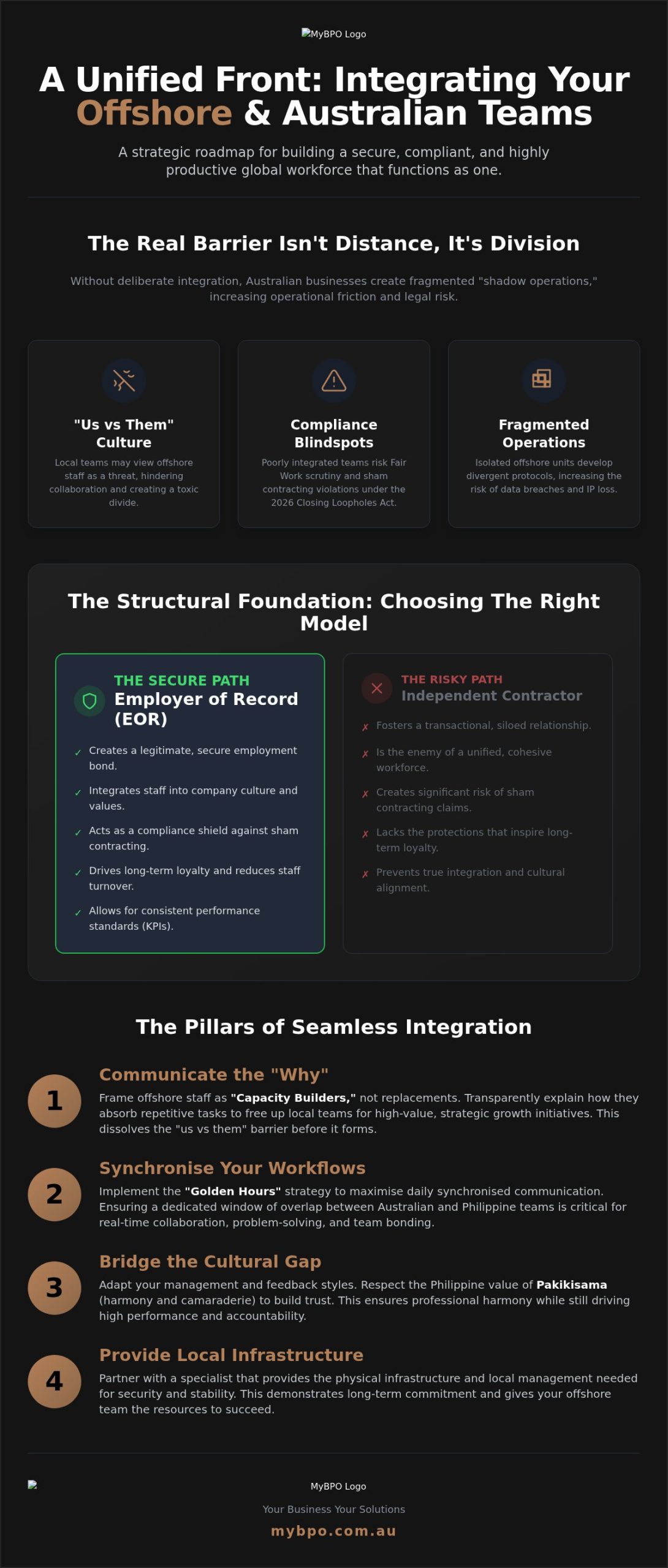
Local employees frequently view an offshore team as a threat to their job security rather than a strategic asset. To mitigate this, management must position offshore staff as “capacity builders” who absorb repetitive tasks to allow local teams to focus on high-level growth. Success depends on internal transparency. You must communicate the “why” behind the hire before the first day of training begins. When your Australian staff realise that their new colleagues are there to support their own career progression, the mental barrier dissolves and collaboration begins.
Regulatory Consequences of Poor Integration
Poorly managed virtual teams often suffer from communication breakdowns that lead to data breaches or the loss of intellectual property. If your offshore staff operate in a vacuum, your ability to enforce Australian standards diminishes. This lack of oversight also invites Fair Work scrutiny, particularly under the 2026 Closing Loopholes Act updates. If the relationship lacks the hallmarks of deep integration, it risks being classified as sham contracting. Integration acts as the bridge between Australian strategy and Philippine execution. Mastering how to integrate offshore team with local team ensures that every person, regardless of their postcode, operates under a unified compliance shield. This structural alignment is the only way to safely scale without exposing the company to avoidable legal liability.
Securing the Structural Foundation: Compliance as Integration
True integration is impossible when the legal foundation of the relationship is fractured. Many Australian firms mistakenly rely on the “Independent Contractor” model to save on overheads, but this approach is fundamentally the enemy of a unified workforce. It places the staff member in a transactional silo, preventing them from being absorbed into your company culture. To master how to integrate offshore team with local team, you must move beyond the limitations of freelance agreements and establish a legitimate employment bond.
An Employer of Record (EOR) provides the structural integrity required for staff to feel like legitimate employees rather than temporary help. In 2026, the implications of the Closing Loopholes Act have made it clear that the Australian government is scrutinising offshore arrangements with greater intensity. By avoiding sham contracting risks, you protect the Australian parent entity from the threat of heavy fines and reputational damage. Legal stability is the first step toward cultural cohesion.
EOR vs Independent Contracting
Contractors remain “outside” the team by design. They lack the protections and sense of belonging that drive long-term loyalty. Utilizing an EOR allows you to apply Australian-style KPIs within the framework of Philippine labour laws, creating a consistent performance standard across your entire organisation. This model also manages mandatory benefits, which are critical for retention in a competitive market. As of January 2026, the Social Security System (SSS) contribution rate is 15 per cent, with the employer responsible for 10 per cent. When you factor in the PhilHealth premium (5 per cent shared equally) and the mandatory 13th-month pay, you aren’t just complying with the law; you’re building a foundation of employee trust that a freelance contract can’t replicate.
Jurisdictional Security and IP Protection
Integration also requires your offshore unit to operate under the same security protocols as your local office. This is difficult to achieve with home-based contractors using personal devices. Professional Employer of Record services ensure your team works from secure, managed facilities with robust IT infrastructure. Australian-owned oversight is vital here. It ensures that your commercial secrets and intellectual property are protected by managers who understand the gravity of Australian privacy standards. Physical asset security in the Philippines provides the final layer of protection, ensuring your equipment and data remain secure within a controlled environment. This structural alignment is the only way to turn a distant unit into a seamless extension of your business.
Synchronising Workflows: Tools and Communication Rhythms
Effective synchronisation requires more than shared software; it demands a disciplined approach to time. The “Golden Hours” strategy focuses on the 2 to 3 hour overlap between Australian and Philippine time zones. This window is not for solo work. It’s for high-impact collaboration, problem-solving, and strategic alignment. Outside these hours, your team relies on a “Source of Truth.” Whether you use Jira, Asana, or Monday.com, every task must be documented. If it isn’t in the project management tool, it doesn’t exist. This level of transparency is essential for anyone learning how to integrate offshore team with local team without succumbing to the chaos of fragmented workflows.
Daily huddles serve as a humanising force. A fifteen-minute morning meeting allows your local and offshore staff to synchronise their daily objectives and flag potential blockers. Standardising documentation ensures that a Philippine team member can pick up exactly where a local staffer left off at the end of the Australian day. This creates a continuous cycle of productivity rather than a disjointed series of handovers. When you absorb these rhythms into your daily operations, you mitigate the risk of tasks falling through the cracks.
Communication Protocols for Australian Businesses
Establishing clear protocols prevents the ambiguity that leads to operational friction. You must set definitive expectations for response times on platforms like Slack or Microsoft Teams. We recommend a “Video First” rule for all meetings. Seeing faces is non-negotiable for building trust and ensuring that non-verbal cues aren’t lost in translation. To foster social bonding, organise “Digital Watercoolers,” which are informal channels where staff can interact without the pressure of deliverables. This builds the rapport necessary for a unified culture across jurisdictional boundaries.
Infrastructure and Equipment Security
Relying on “Bring Your Own Device” (BYOD) policies is a significant security vulnerability. It undermines your control over data and prevents a uniform standard of performance. The strategic alternative is leasing enterprise-grade equipment for your Philippine team. This ensures that every staff member has the hardware required for high-level output while maintaining rigorous security protocols. Professional workspaces provide redundant internet connections and a controlled environment, ensuring that your operations remain resilient against local infrastructure challenges. Secure infrastructure is the physical foundation of how to integrate offshore team with local team successfully.
Bridging the Cultural Gap Between Australia and the Philippines
Bridging the cultural divide is a prerequisite for operational security. Australian managers are typically known for their “flat” hierarchy and blunt directness. In contrast, the Philippine workforce values “Pakikisama,” which prioritises social harmony and collective agreement. If you apply an unrefined Australian feedback style, you risk causing an offshore staff member to “save face” and withdraw from active communication. This silence represents a significant operational risk. Understanding how to integrate offshore team with local team dynamics requires a nuanced approach to feedback where criticism is delivered privately and framed as a collective improvement goal.
Structural culture also plays a vital role in retention. The “13th Month Pay” is a mandatory payment in the Philippines, equivalent to one-twelfth of the basic annual salary, and must be paid by 24 December. Overlooking these local traditions undermines the employer-employee bond and creates resentment. Training your Australian staff on Cultural Intelligence (CQ) is essential to avoid unintentional friction that could lead to high turnover and a loss of institutional knowledge.
Understanding the Philippine Work Ethic
The Philippine workforce places a high value on loyalty and family. Fostering a sense of “Malasakit,” which translates to a deep sense of care or ownership over one’s work, is the ultimate goal of integration. When staff feel that their work directly benefits the “family” of the business, productivity and engagement increase. You must also account for local holidays, such as Holy Week, which can impact your Australian workflow planning if not managed proactively through a structured calendar.
Onboarding for Long-Term Alignment
The first 90 days are critical for successful offshore recruitment. Assigning a “Local Buddy” to every new offshore hire provides an informal channel for cultural exchange and technical support. This peer-to-peer connection humanises the distance and accelerates the learning curve. Regular “Pulse Checks” allow management to identify integration friction before it escalates into a resignation. If you are ready to secure your global workforce through expert local management, partner with an Australian-owned EOR specialist to protect your offshore operations.
Scaling Your Integrated Workforce with MyBPO
Scaling a global workforce requires a partner that understands the Australian regulatory environment as deeply as the Philippine labour market. As your business grows, the transition from a single virtual assistant to a high-performance multi-role department presents new operational challenges. Without a robust framework, the complexity of managing disparate units can quickly erode the benefits of offshoring. We act as your local Australian ally, providing a physical Philippine presence that ensures your team remains aligned with your core objectives. Learning how to integrate offshore team with local team structures at scale is about maintaining the same level of accountability you expect from your home office.
Australian-owned BPOs offer a superior security layer because they operate under the same professional gravity as their clients. We don’t just provide talent; we provide a “compliance shield” that protects your parent entity from the shifting sands of international employment law. If you’re ready to expand, the first step is a comprehensive compliance and integration audit. This process identifies hidden liabilities in your current workflows and provides a clear path to a unified, secure operation.
The MyBPO Managed Framework
Our managed framework is designed to absorb the administrative burden of payroll and compliance through our dedicated Employer of Record services. We navigate the intricacies of Philippine labour codes, ensuring that your staff receive all mandatory benefits while you focus on high-level strategy. Our on-the-ground support teams provide a human presence that digital-only platforms cannot replicate. By providing your staff with dedicated workspaces in a professional environment, we ensure they have the infrastructure and security required for enterprise-grade output. This physical grounding is what allows a distant unit to function as a seamless extension of your local staff.
Your Vigilant Guardian in Offshore Staffing
Success in 2026 requires moving beyond simple transactional outsourcing. You need a true global partnership defined by Australian accountability and transparency. We take on the burden of risk, allowing you to scale with the confidence that your intellectual property and commercial secrets are secure. This protective approach ensures that as you learn how to integrate offshore team with local team protocols, your business remains resilient against legal and operational friction. To secure your offshore future and move toward a high-performance model, organise a consultation with MyBPO today.
Securing Your Global Operational Future
Building a unified workforce is no longer a matter of simple cost reduction; it’s a strategic necessity that requires a resilient, compliant extension of your Australian operations. Success in 2026 demands a shift away from fragmented contractor models toward a unified structure that respects both Fair Work standards and Philippine labour codes. By mastering how to integrate offshore team with local team workflows, you mitigate the risks of data breaches, intellectual property loss, and high staff turnover that stem from operational isolation.
The path to a seamless global workforce is built on structural integrity and cultural intelligence. Integration is your compliance shield. As an Australian-owned and operated specialist with a physical presence in both Australia and the Philippines, MyBPO acts as your vigilant guardian. We ensure total compliance with DOLE and Fair Work regulations, allowing you to focus on growth while we secure your operational foundation. Secure your offshore expansion with MyBPO’s Australian-owned EOR services. With a reliable local ally, your offshore unit will become a high-performance asset that drives your business forward with confidence.
Frequently Asked Questions
How do I manage the time zone difference between Australia and the Philippines?
Managing the time difference involves maximising the two to three hour overlap between the Philippines and Australia for synchronous collaboration. You should schedule all high-priority huddles and strategy sessions during this window to ensure real-time alignment. For the remaining hours, utilise project management tools to maintain a clear “Source of Truth.” This approach provides a structured roadmap for how to integrate offshore team with local team workflows so it doesn’t require constant supervision.
Is it better to hire a contractor or use an EOR for integration?
An Employer of Record (EOR) is the superior choice for deep integration because it establishes a legitimate employment bond rather than a transactional freelance relationship. Contractors often remain culturally isolated and present significant sham contracting risks under the 2026 Closing Loopholes Act. By using an EOR, you provide staff with mandatory Philippine benefits and a stable career path, which fosters the loyalty and long-term commitment necessary for a unified, high-performance global workforce.
How can I ensure my offshore team understands Australian business culture?
Ensuring cultural alignment requires active training in Cultural Intelligence (CQ) for both your local and offshore staff. You must explicitly discuss the contrast between Australian directness and the Philippine value of “Pakikisama” or social harmony. Implementing a “Local Buddy” system helps humanise the distance and provides a safe space for offshore staff to ask questions about Australian idioms or business expectations. This proactive bridge-building prevents the misunderstandings that often lead to operational friction.
What tools are best for managing a hybrid onshore-offshore team?
A hybrid team thrives when everyone operates from a centralised “Source of Truth” using tools like Jira, Asana, or Monday.com. These platforms ensure that every task is documented and visible across jurisdictions. For communication, we recommend a “Video First” policy on Microsoft Teams or Slack to build rapport. Standardising these tools is a fundamental step in how to integrate offshore team with local team operations, ensuring that physical distance does not result in information silos.
Do Australian Fair Work laws apply to staff in the Philippines?
While the Fair Work Act generally applies to employees within Australia, the 2026 Closing Loopholes Act has increased scrutiny on offshore arrangements. If a relationship is misclassified as a contractor when it functions like employment, the Australian parent entity may face severe penalties. It’s essential to utilise an EOR as a compliance shield, ensuring the worker is legally employed under Philippine law while maintaining the structural standards expected by Australian regulatory bodies.
What is the “13th month pay” and is it mandatory for integrated teams?
The 13th-month pay is a mandatory statutory benefit in the Philippines equivalent to one-twelfth of an employee’s basic annual salary. It must be paid to all rank-and-file employees by 24 December each year. For an integrated team, failing to provide this benefit is not only a legal breach of Philippine labour codes but also a significant cultural oversight that will damage morale and increase turnover. Professional EOR services manage these payments automatically to ensure total compliance.
How do I protect my intellectual property when working with offshore staff?
Protecting intellectual property requires a combination of robust legal contracts and physical infrastructure. You should ensure your offshore staff work from secure, managed workspaces rather than unmonitored home environments. By using an Australian-owned EOR, your commercial secrets are protected by managers who understand Australian privacy standards. This structural security prevents data breaches and ensures that your proprietary information remains within a controlled, enterprise-grade environment that mirrors your local office protocols.
Can I provide my offshore team with the same equipment as my local team?
You can and should provide your offshore team with enterprise-grade equipment to ensure they meet the same performance standards as your local staff. Relying on “Bring Your Own Device” (BYOD) policies introduces significant security vulnerabilities and hardware inconsistencies. It’s better to lease equipment through a specialist provider to secure your operations with standardised laptops. This ensures your Philippine team has the professional tools required to function as a seamless extension of your business.
Need a strategy session?
Tell us about your team and we will map out the right structure, fixed-cost quote included.
Book a call