Blog
How to Hire in the Philippines Legally: The 2026 Australian Business Guide

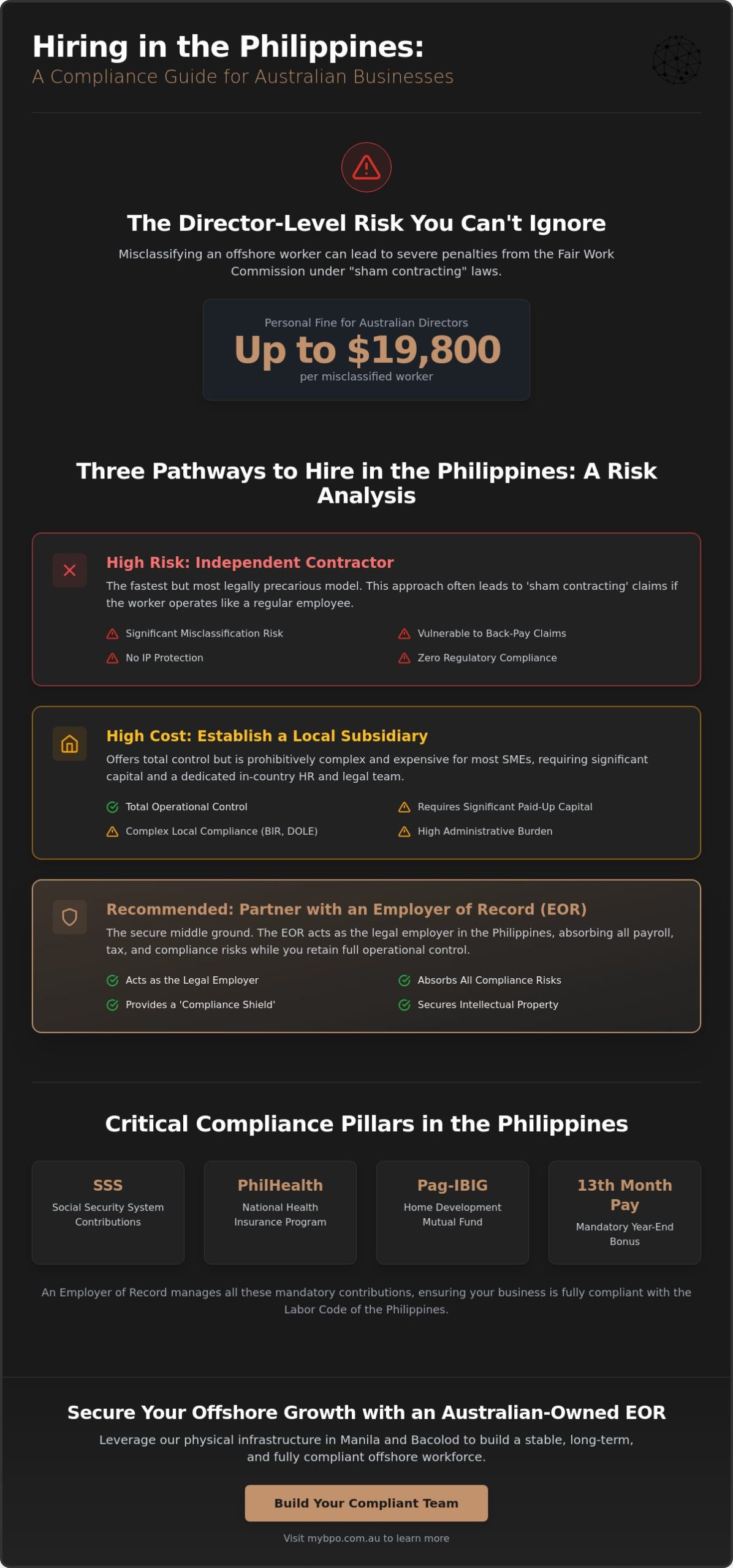
Did you know that an Australian director can face personal fines of up to $19,800 for misclassifying a single offshore worker? The financial risk is real, and it’s why understanding how to hire in Philippines legally has become a critical priority for Australian businesses in 2026. You likely want the efficiency of offshore growth but feel hesitant about the complexities of foreign tax codes and the looming threat of ‘sham contracting’ penalties from the Fair Work Commission.
It’s a valid concern because the intersection of Australian and Philippine employment law is notoriously difficult to manage alone. This guide provides a clear, risk-aware roadmap to help you build a compliant team while absorbing the legal burden that usually falls on your shoulders. We’ll examine the mandatory 2026 contribution rates for SSS and PhilHealth, detail how to mitigate director liability, and ensure your intellectual property remains secure in a foreign jurisdiction.
Key Takeaways
- Identify the three primary legal pathways for engagement and why the ‘borderless’ freelancer model often leads to significant regulatory vulnerability.
- Master the essentials of how to hire in Philippines legally by correctly calculating mandatory SSS, PhilHealth, and Pag-IBIG contributions alongside 13th-month pay.
- Protect Australian directors from personal liability by understanding how the Fair Work Commission identifies and penalises sham contracting in offshore arrangements.
- Mitigate operational risks and secure your intellectual property by leveraging an Australian-owned Employer of Record with physical infrastructure in Manila and Bacolod.
- Establish a stable, long-term offshore workforce by moving beyond stop-gap measures and implementing a structured, dual-jurisdiction compliance framework.
Navigating the AU-PH Corridor: Can You Hire Legally Without an Entity?
The Philippines remains the primary destination for Australian SMEs seeking to scale operations in 2026. This attraction is driven by a deep talent pool and high English proficiency. However, a dangerous misconception persists that digital connectivity equates to legal flexibility. Many businesses mistakenly believe they can bypass local regulations by treating staff as “borderless” freelancers. This is a legal myth. Understanding how to hire in Philippines legally requires acknowledging that you cannot operate in a vacuum. Every worker within Philippine territory is protected by local statutes, regardless of where your head office is located.
The fundamental requirement for any Australian firm is simple: you must have a legal employer of record in-country. Without a registered Philippine entity or a compliant partner, your business lacks the standing to remit taxes, pay mandatory contributions, or enforce intellectual property rights. Attempting to manage an offshore team through informal payment channels creates a fragile foundation that can collapse under the slightest regulatory scrutiny.
The Reality of Jurisdictional Boundaries
Philippine courts are historically protective of their workforce. If a foreign entity engages a local citizen to perform tasks essential to the business, the relationship is viewed as employment, not a simple commercial transaction. Engaging staff without a local legal presence often constitutes “Doing Business Without a License” under the Revised Corporation Code. A standard service agreement cannot override the Labor Code of the Philippines, which mandates specific protections and benefits for all regular employees. If your operational structure doesn’t account for these local laws, you aren’t just hiring; you’re creating a significant liability.
Australian Director Liability in Offshore Hiring
The risk isn’t confined to Manila. Australian directors hold a non-delegable duty of care that extends to their offshore operational structures. If an offshore arrangement is found to be a sham, it can trigger domestic audits by the Australian Taxation Office or the Fair Work Commission. Poor compliance in the Philippines often serves as a red flag for regulators at home. To mitigate these risks, many firms utilise an employer of record Australia. This structure provides a compliance shield by ensuring the legal burden of employment is absorbed by a local specialist, effectively insulating the Australian parent company and its directors from direct jurisdictional fallout.
The Three Primary Pathways for Australian Businesses to Hire Legally
Determining how to hire in Philippines legally requires choosing a structural framework that balances operational control with risk mitigation. Australian firms typically evaluate three distinct avenues: establishing a local subsidiary, engaging independent contractors, or partnering with an Employer of Record (EOR). Each carries a different risk profile and administrative weight. While the allure of low-cost contracting is strong, the legal reality often dictates a more structured approach to ensure long-term stability and compliance.
Direct incorporation involves registering with the Securities and Exchange Commission (SEC) in Manila. This path grants total control but requires significant paid-up capital and ongoing compliance with the Bureau of Internal Revenue (BIR). You can find more detail on these requirements in the BOI FAQs on Doing Business. For most SMEs, the complexity of managing local audits and DOLE reports without a dedicated in-country HR department makes this option prohibitively expensive.
The independent contractor model is often the default for businesses starting small. It’s fast, but it is legally the most precarious. If the worker performs regular duties under your direct control, both Philippine and Australian regulators may deem them an employee. This misclassification exposes you to back-pay claims and heavy penalties. Before adopting this model, it’s worth understanding the full risks of hiring contractors in the Philippines that many Australian firms overlook. Partnering with an EOR provides a secure middle ground. The EOR acts as the legal employer, absorbing all payroll, tax, and compliance risks while you maintain day-to-day management. This is the most reliable method for those determining how to hire in Philippines legally without the massive overhead of a foreign branch.
Local Incorporation vs. EOR
Registering a branch requires navigating a labyrinth of local bureaucracy. Beyond the initial setup, you must manage monthly tax filings and annual labour reports. For teams of fewer than 50 staff, the overhead of a full corporate presence rarely justifies the investment. An EOR allows you to bypass these capital requirements and administrative burdens, providing immediate speed to market without sacrificing legal integrity or corporate security.
The Strategic Advantage of an Australian-Owned EOR
Managing an offshore team requires a bridge that understands both Australian standards and Philippine labour codes. When evaluating direct hire Philippines vs BPO models, the security of an Australian-owned partner is paramount. This ensures your IP protection meets Australian expectations while remaining enforceable on the ground. Understanding the difference between Employer of Record and Business Process Outsourcing is essential before committing to a structural framework, as each model carries distinct legal obligations and levels of operational control. If you’re looking to secure your offshore operations with an expert ally, an Australian-led EOR is the most robust compliance shield available.
The Contractor Trap: Avoiding Sham Contracting and Fair Work Risks
Many Australian businesses fall into the “contractor trap” by assuming that offshore status automatically exempts them from domestic labour laws. This assumption is a dangerous legal oversight. The Fair Work Commission (FWC) has increasingly scrutinised offshore arrangements, particularly where a worker has a “sufficient connection” to Australia. If you’re investigating how to hire in Philippines legally, you must understand that the FWC doesn’t just look at the contract; it looks at the reality of the daily work. If you control their hours, provide their equipment, and demand exclusivity, that “freelancer” is likely an employee in the eyes of Australian law.
The implementation of the Closing Loopholes Act in 2025 and 2026 has fundamentally shifted the burden of proof. Flexibility for the employer often translates to significant liability when those arrangements lack a robust legal foundation. Regulators now use a “totality of the relationship” test that prioritises the practical reality of the work over whatever labels are written in a service agreement. For an Australian director, the consequences of getting this wrong are no longer just administrative; they’re financial and personal.
The Misclassification Risk
The “Multi-Factor Test” remains the primary tool for Australian regulators to determine worker status. It examines several key indicators: the level of control you exercise, who provides the tools of trade, and whether the worker can delegate tasks to others. If your offshore staff member functions as an integrated part of your team, they’re likely misclassified. The financial stakes are high. Under 2026 regulations, civil penalties for businesses with 15 or more employees start at the greater of $495,000 per contravention or three times the total underpayment amount. You can read more about these specific dangers in our guide on the sham contracting Philippines risk. Sham contracting is defined under the Fair Work Act as the misrepresentation of an employment relationship as an independent contracting arrangement, a definition significantly strengthened by the 2025 and 2026 amendments to include stricter objective tests of the totality of the relationship.
Protecting Your Australian Business from Back-Pay Claims
The risk of misclassification often manifests in back-pay claims for entitlements like annual leave, sick leave, and public holiday rates. If a Philippine worker is deemed an employee, they may be entitled to the same protections as their Australian counterparts. A compliant EOR structure acts as a vital jurisdictional firewall. By ensuring the worker is legally employed by a Philippine entity that handles all local benefits and taxes, you effectively decouple the Australian parent company from direct employment liability. Consider the case of an Australian tech firm that was recently forced to settle a six-figure back-pay claim because their “contractors” in Manila were found to be regular employees under the FWC’s expanded definitions. Australian firms that have examined the structural risks of hiring contractors Philippines-based consistently find that this scenario is entirely avoidable with the right structural protection.
Critical Compliance Pillars: DOLE, Mandatory Benefits, and the 13th Month
The Department of Labor and Employment (DOLE) serves as the primary regulator for workforce standards in the Philippines. For an Australian business, DOLE’s role is non-negotiable. If you’re learning how to hire in Philippines legally, you’ll quickly find that this agency prioritises worker protection above all else. Failing to register your workers or miscalculating their benefits isn’t just an administrative error. It’s a legal breach that can lead to site inspections, fines, and the potential blacklisting of your business from future offshore operations. Compliance isn’t a choice; it’s the foundation of your operational security.
The ‘Big Three’ Mandatory Contributions
Compliance is built on three specific pillars of social security that must be remitted monthly. The Social Security System (SSS) functions similarly to Australian superannuation but with a more rigid contribution structure. As of June 2026, the total SSS rate is 15%, with the employer absorbing 10% and the employee contributing 5%. PhilHealth contributions are set at 5% of the basic salary, shared equally between both parties at 2.5% each. The Pag-IBIG Fund, which supports housing development, is capped at a contribution of ₱200 each for the employer and employee for salaries exceeding ₱5,000. Managing these across multiple government portals requires a level of administrative precision that few Australian firms can handle without local support.
Managing Philippine Payroll Cycles
The payroll landscape in the Philippines follows a semi-monthly rhythm, with staff traditionally paid on the 15th and 30th. This cycle is more than just a calendar preference; it’s a cultural expectation that impacts employee retention. If you miss a deadline or miscalculate a night shift differential, you risk losing your best talent to more compliant competitors. Recent data suggests that 49% of employees will consider leaving after just two payroll mistakes. This is why having a deep understanding of payroll Philippines for Australian companies is essential for long-term stability.
The 13th Month Pay remains the most critical statutory requirement. It’s a mandatory payment equivalent to 1/12th of the employee’s total basic salary earned during the year, and it must be distributed by December 24th. It isn’t a performance bonus; it’s a legal entitlement. To ensure your business remains above board and protected from DOLE audits, you should partner with an Australian-owned EOR that manages these complex remittances on your behalf. This structure ensures that every peso is accounted for and every tax filing with the Bureau of Internal Revenue is completed with professional gravity.
Securing Your Operations with an Australian-Owned EOR
Navigating the final stages of how to hire in Philippines legally requires a shift from theoretical compliance to operational security. While digital platforms offer a veneer of connectivity, they rarely provide the legal or physical protection an Australian business needs to safeguard its interests. Relying on a purely digital intermediary leaves your business vulnerable to jurisdictional gaps. True security is found in a partner that maintains a physical presence in both your home market and the offshore location. MyBPO operates with a head office in Brisbane, providing a direct line of accountability governed by Australian law, while simultaneously managing robust infrastructure in Manila and Bacolod to support your team on the ground.
By moving beyond the “freelancer” model, you transition into building a professional offshore workforce that is integrated, stable, and protected. An Australian-owned Employer of Record (EOR) acts as your compliance shield, absorbing the administrative and legal burdens that would otherwise fall on your directors. This structure allows you to focus on growth while we secure the foundation, ensuring that every operational risk is mitigated before it can impact your Australian entity.
For firms that require similar high-quality staffing expertise in the traffic, service, or logistics sectors within Europe, you can discover MonPilaar to see how they manage skilled personnel requirements with professional integrity.
Similarly, for businesses whose offshore expansion involves physical products and distribution, finding reliable logistics partners is vital. To streamline your supply chain, warenous.com helps you find a pre-screened 3PL warehouse to manage your inventory and distribution requirements globally.
On-the-Ground Support and Physical Security
The “Work From Home” model has become a significant liability for data-sensitive roles in 2026. Without a controlled environment, ensuring the integrity of your intellectual property and client data is nearly impossible. Implementing dedicated workspace Philippines solutions provides a level of security that remote arrangements simply cannot match. A professional office environment ensures that staff have access to redundant internet, enterprise-grade IT support, and secure hardware. Furthermore, physical workspaces significantly improve employee retention by fostering a professional culture, which is essential for maintaining a long-term, compliant team. Our equipment leasing services further safeguard your operations by keeping all hardware under your control, preventing the risks associated with “Bring Your Own Device” policies.
The MyBPO Advantage for Australian Firms
The primary advantage of partnering with an Australian-owned EOR is the removal of the cultural and legal “black hole” that often exists in offshore hiring. You deal with a local partner who understands Australian business standards, reporting requirements, and the specific anxieties of domestic directors. This direct accountability ensures that your offshore team is treated with the same professional gravity as your local staff, leading to higher morale and lower turnover. MyBPO mitigates Australian director liability through its EOR structure by acting as the primary legal entity responsible for Philippine labour code compliance, effectively insulating the Australian parent company from direct jurisdictional exposure. This allows you to scale with confidence, knowing that your offshore expansion is built on a foundation of total legal and operational integrity.
Build a Compliant and Secure Offshore Future
Scaling your business through offshore talent shouldn’t involve compromising your legal standing or exposing your directors to avoidable risk. The complexity of the 2026 regulatory landscape makes it clear that informal models are no longer a viable strategy for serious Australian firms. Understanding how to hire in Philippines legally is the essential first step toward transforming a potential liability into a stable, high-performing extension of your local team. By moving toward a structured Employer of Record framework, you ensure that every mandatory contribution is paid and every jurisdictional requirement is met with precision.
As specialists in the AU-PH compliance corridor, MyBPO provides the physical infrastructure and Brisbane-based management needed to secure your expansion. We maintain active operations in Manila and Bacolod to ensure your workforce remains stable and your data stays protected. You can lean on a partner that absorbs the legal burden, allowing you to focus on growth while we act as your compliance shield. This approach allows you to build a professional offshore team without the administrative weight of a foreign branch.
Secure your offshore expansion with MyBPO’s Australian-owned EOR services and start building your risk-free team today. The opportunity for growth in the Philippines is immense when you have the right protection in place.
Frequently Asked Questions
Is it legal to hire someone in the Philippines as a contractor?
Hiring a Philippine citizen as a contractor is legal only if the individual is genuinely independent and maintains their own business permits. If you exercise direct control over their methods, hours, and equipment, local labour courts will likely reclassify them as a regular employee. This misclassification is a primary risk for businesses navigating how to hire in Philippines legally without a structured local entity.
Do I need to pay the 13th month pay to my offshore staff?
Yes, the 13th-month pay is a statutory requirement for all regular rank-and-file employees in the Philippines who have worked for at least one month. It is equivalent to 1/12th of the employee’s total basic salary earned during the year and must be paid by December 24th. Failing to remit this payment is a serious breach of the Philippine Labor Code and often triggers DOLE audits.
What are the risks of using a ‘borderless’ payroll platform?
Borderless platforms often lack a physical on-the-ground presence, which creates a significant compliance gap. While these digital services handle currency transfers, they rarely provide the physical security, equipment leasing, or local HR support needed to mitigate risk. This lack of a local “safe harbour” leaves Australian directors vulnerable to personal liability under domestic sham contracting laws if the relationship is ever challenged.
How does the Australian Fair Work Act apply to my Philippine team?
The Fair Work Act applies if there’s a “sufficient connection” between the offshore worker and the Australian business. If your Australian entity directs the daily tasks and the worker is integrated into your domestic operations, the Fair Work Commission may deem them an employee rather than a contractor. This exposure remains a critical concern for firms learning how to hire in Philippines legally in the 2026 regulatory environment.
Do I need to register my Australian business with the Philippine SEC?
You only need to register with the Philippine Securities and Exchange Commission (SEC) if you intend to establish a local subsidiary or branch office. If you choose to use an Employer of Record (EOR), the EOR acts as the legal entity in-country. This allows you to engage staff legally without the capital requirements or administrative burden of managing a foreign corporation yourself.
What happens if I misclassify an employee as a contractor in the Philippines?
Misclassification often results in “regularization,” where the Department of Labor and Employment (DOLE) mandates that the worker be granted full employee status. You’ll be liable for all back-dated mandatory contributions, including SSS and PhilHealth, plus 13th-month pay and leave entitlements. In Australia, this same misclassification can trigger severe civil penalties under the Fair Work Act’s sham contracting provisions.
How do I ensure my intellectual property is protected in the Philippines?
IP protection is best secured through an Australian-owned EOR that provides dual-jurisdiction contracts enforceable in both countries. Physical security measures, such as dedicated workspaces in Manila or Bacolod, further protect your data by preventing the IP leakage common in unmonitored home environments. Relying on a simple service agreement with a freelancer is rarely sufficient to protect sensitive corporate assets.
What is the difference between an EOR and a traditional BPO?
An EOR acts as the legal employer for staff you manage directly, providing you with full operational control over their daily tasks. A traditional BPO usually provides a managed service where the BPO provider controls the output and the team’s management. For a comprehensive breakdown of how these two models compare in terms of compliance obligations, IP protection, and 2026 regulatory requirements, review our detailed guide on the difference between Employer of Record and Business Process Outsourcing to determine which structure best suits your Australian business. The EOR model is typically preferred by Australian firms that want to integrate offshore staff directly into their existing company culture and workflows.
Need a strategy session?
Tell us about your team and we will map out the right structure, fixed-cost quote included.
Book a call