Blog
How to Hire and Manage Remote Staff for Australian Growth

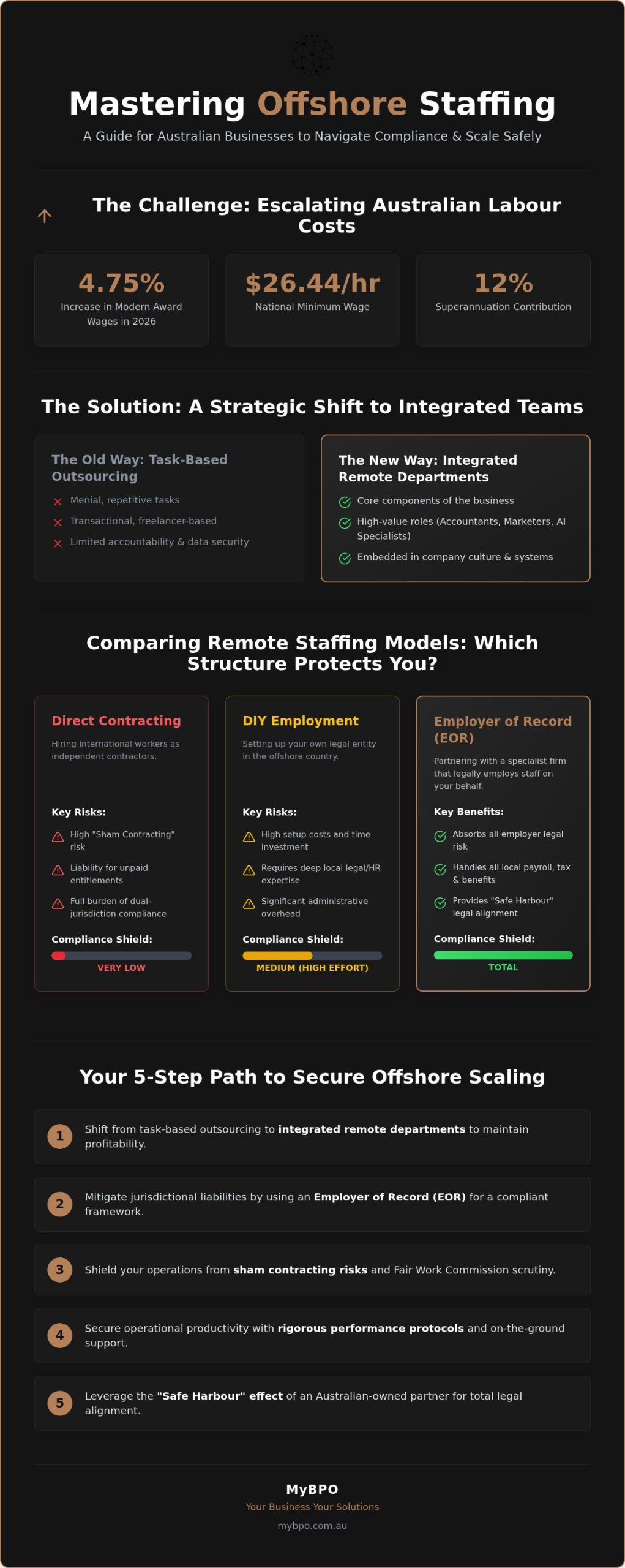
Scaling your Australian business by hiring offshore isn’t just a cost-saving exercise; it’s a high-stakes legal manoeuvre where a single compliance error can trigger a Fair Work Commission audit. You likely recognise that rising local labour costs and the 4.75% increase in modern award wages in 2026 are making it harder to maintain healthy margins. While the Philippines offers a deep pool of talent, the complex web of foreign labour laws often feels like an insurmountable barrier for many directors.
This guide will show you how to master offshore compliance and operational management to scale your business with high-performing remote staff while maintaining a total compliance shield. We’ll break down how to use an Employer of Record to absorb risk, navigate jurisdictional boundaries, and build a productive team that feels like a natural extension of your local operations. You will learn how to secure your business against legal friction while significantly reducing your operational overheads through a structured, risk-aware approach to international employment.
Key Takeaways
- Shift from task-based outsourcing to integrated remote departments to maintain profitability against escalating Australian labour costs.
- Mitigate complex jurisdictional liabilities by employing an Employer of Record (EOR) to secure your remote staff within a compliant framework.
- Navigate the 2026 regulatory environment to ensure your offshore operations are shielded from sham contracting risks and Fair Work Commission scrutiny.
- Secure operational productivity by combining rigorous performance protocols with tangible, on-the-ground support to maintain high-performance standards.
- Leverage the “Safe Harbour” effect of an Australian-owned partner to ensure legal alignment and structural integrity for your offshore expansion.
The Evolution of Remote Staff in the Australian Business Landscape
The landscape of international employment has shifted significantly. In 2026, Australian firms are no longer viewing offshore support as a repository for menial, repetitive tasks. Instead, there is a clear transition toward building integrated remote departments that function as core components of the domestic business. The Evolution of Remote Staff has moved from transactional outsourcing to a strategic expansion model designed to absorb the pressure of rising domestic operational costs.
With the national minimum wage reaching $26.44 per hour and superannuation contributions fixed at 12%, Australian SMEs face a critical choice: stagnate under local labour costs or secure a scalable workforce elsewhere. Choosing remote staff in the Philippines allows businesses to maintain competitiveness without compromising on quality. Unlike a freelancer, who operates on a per-project basis with limited accountability, a dedicated remote team member is embedded into your company’s systems, culture, and long-term objectives. This distinction is vital for risk mitigation; a dedicated structure ensures consistent performance and data security that a gig-economy marketplace cannot provide.
Beyond the Virtual Assistant: Strategic Remote Roles
Modern offshore teams now encompass sophisticated technical and professional functions. Australian businesses are increasingly recruiting for high-value roles such as certified accountants, digital marketing strategists, and AI Human in the loop specialists who oversee automated workflows. This shift allows local leadership to focus on high-level growth while their Philippine counterparts manage the technical execution. By establishing these long-term career paths, firms reduce turnover and secure a stable operational foundation that supports 24/7 productivity.
The Cultural Synergy Between Australia and the Philippines
The Philippines remains the primary destination for Australian expansion due to deep-rooted cultural and logistical alignment. Shared time zones and minimal offsets allow for real-time collaboration without the friction of delayed communication. Philippine business education is heavily Westernised, producing professionals who understand Australian communication styles and professional etiquette. This synergy is especially critical for customer-facing roles, where nuances in language and tone can significantly impact brand reputation. When a business integrates remote staff from this region, they are not just hiring labour; they are securing a partnership with a workforce that shares their professional values and operational rhythm.
Navigating the Legal Minefield: Fair Work and Offshore Compliance
An Employer of Record (EOR) serves as the primary risk mitigation tool for Australian firms by assuming the legal responsibility for offshore staff, thereby insulating the domestic entity from foreign regulatory breaches. As we move through 2026, the implications of the Fair Work Act have become increasingly stringent for those managing a global workforce. The “Closing Loopholes” legislation has effectively narrowed the definition of an independent contractor, making direct international contracting a high-risk strategy for any Australian director. If a worker is deemed an employee under Australian law, the business remains liable for unpaid entitlements, regardless of where the person is physically located. This includes potential back-payments for leave and other statutory benefits that were bypassed during the initial engagement.
Compliance does not stop at the Australian border; it requires a dual-jurisdictional approach. In the Philippines, employers must navigate specific statutory requirements including 13th-month pay, Social Security System (SSS) contributions, PhilHealth, and Pag-IBIG (Home Development Mutual Fund). Failure to remit these payments correctly can lead to legal action within the Philippine Department of Labour and Employment (DOLE). It isn’t just about paying a salary; it’s about adhering to a rigid framework of social protections.
Exposing the Dangers of Sham Contracting
The Fair Work Commission employs a “multi-factorial” test to determine whether a worker is a genuine contractor or an employee in disguise. They examine the degree of control, the provision of equipment, and the expectation of ongoing work. Misclassifying your remote staff can result in severe financial penalties for Australian directors, including personal liability for back-payments and fines. Understanding the sham contracting Philippines risk is now the most critical step in any offshore expansion strategy.
Jurisdictional Security: Who is the Legal Employer?
A direct hire model places the entire burden of Philippine labour law on your Australian company, often without the protection of a local legal entity. Conversely, engaging remote staff through an EOR model establishes a “compliance shield” where the partner absorbs the legal liability of employment. This structure ensures that your intellectual property is protected through enforceable local contracts that align with both Australian and Philippine standards. When Managing Performance and Securing Data, having a legal framework that recognises the EOR as the employer provides a clear path for dispute resolution. If you want to scale without the friction of legal uncertainty, choosing a partner that provides Australian-owned Employer of Record services is essential.
Comparing Remote Staffing Models: Which Structure Protects Your Firm?
Choosing the right model is a decision of structural integrity. While freelance marketplaces offer immediate access to remote staff, they provide no legal recourse or protection against the Fair Work Commission audits discussed previously. A business must weigh the nominal upfront savings against the potential for catastrophic compliance costs if a worker is misclassified. If a worker operates without a formal employment contract that satisfies both Australian and Philippine standards, the business owner remains personally exposed to liability for unpaid entitlements and tax penalties.
Traditional BPO (Business Process Outsourcing) operates on a “black box” principle where the client pays for an output rather than an individual. While convenient, this often leads to high staff turnover and a lack of cultural integration. In contrast, the Employer of Record (EOR) model allows you to maintain direct operational control over your team while the provider handles the jurisdictional heavy lifting. Scalability is often the deciding factor; while a freelance model allows for rapid hiring, it fails to provide the structural foundation required for a team of ten or twenty people. As your organisation grows, the lack of centralised management in a freelance or direct-hire model creates a significant administrative burden that can stifle expansion.
EOR vs. BPO: Understanding the Difference
The distinction becomes clearer when examining operational autonomy. Traditional BPO is primarily project-based and transactional; however, an EOR is focused on building an offshore team in the Philippines that functions as an extension of your own office. This model fosters a stronger company culture and significantly higher staff retention because the employees identify with your brand, not the service provider. For businesses prioritising long-term scalability, selecting a specialist Philippines EOR provider ensures that your team is secured by robust, local infrastructure rather than a generic agency. Your offshore team becomes a permanent asset rather than a temporary resource.
The Direct Hire Trap
Many Australian firms initially consider a “DIY” approach to hiring remote staff, only to be met with the administrative reality of foreign entity registration. Setting up a local corporation in the Philippines involves significant SEC registration hurdles, mandatory minimum capital requirements, and ongoing tax filing obligations. The administrative bloat of managing payroll, SSS, and PhilHealth internally often costs more in management hours than the services of an EOR. Most realise that the liability of direct employment without a local presence is a risk that outweighs any perceived savings. Without an on-the-ground partner to manage the physical reality of employment, the “Direct Hire” model often leads to operational friction and legal vulnerability.
Operational Excellence: Managing Performance and Securing Data
Operational success requires more than just legal compliance; it demands a rigorous framework for performance and data integrity. Establishing clear Key Performance Indicators (KPIs) ensures that your remote staff are aligned with your business objectives from the first day of engagement. While digital tools facilitate coordination, the physical reality of on-the-ground support remains the most reliable method for maintaining high-performance standards. Having a local presence in Manila or Bacolod allows for immediate intervention if technical or operational issues arise, providing a level of oversight that abstract digital platforms cannot replicate. This physical oversight is non-negotiable for firms handling sensitive client information.
Securing the Remote Workspace
Relying on home-based environments for sensitive Australian data introduces significant security vulnerabilities. Residential internet connections in the Philippines are often prone to instability, and domestic settings lack the physical security protocols required to protect intellectual property. Utilising a dedicated workspace in the Philippines mitigates these risks by providing enterprise-grade firewalls, redundant power supplies, and restricted access. Security is bolstered through professional equipment leasing, ensuring your team uses modern, secure hardware rather than personal devices that may be compromised. This structural approach secures your operations against both data breaches and hardware-related downtime.
Performance Management for Remote Teams
Effective management involves a balance of accountability and support. Tracking output through project management software allows for transparency without the friction of micromanagement. Regular video check-ins and Australian-style feedback loops are essential for maintaining professional standards and cultural alignment. You must also account for local logistical nuances, such as the mandatory 13th-month pay and the specific Philippine holiday calendar, to avoid operational disruptions. When your remote staff feel integrated into your company’s rhythm, their productivity naturally increases. This “One Team” philosophy across the AU-PH corridor is the foundation of long-term scalability. To begin building a secure and productive offshore department, you can explore our integrated recruitment and workspace solutions for Australian businesses.
Scaling Safely: Why an Australian-Owned EOR is Your Best Ally
Selecting an Australian-owned partner creates a “Safe Harbour” effect that global, non-specialist firms cannot replicate. While a multinational EOR might understand the mechanics of global payroll, they often lack the technical proficiency in the Fair Work Act required to protect an Australian director from domestic scrutiny. MyBPO functions as a dedicated compliance shield, ensuring that every facet of your offshore operation aligns with Australian legal standards and Philippine labour codes simultaneously. Having an Australian-based leadership team means you have a local point of accountability who understands your business culture, while our physical infrastructure in Manila and Bacolod manages the day-to-day reality of your remote staff.
The value of a local point of contact is critical when navigating international disputes or operational shifts. If a challenge arises in Manila, you aren’t dealing with an anonymous support ticket in a distant time zone; you are speaking with a local ally who shares your regulatory environment. This structure allows you to scale with the calm confidence of a specialist who understands the high stakes of international employment. Before you finalise your expansion, ensure you have addressed this 2026 checklist:
- Verify worker classification against the latest Fair Work “Closing Loopholes” multi-factorial tests.
- Validate that 13th-month pay and SSS contributions are remitted by a legally recognised local entity.
- Shift sensitive data processing from residential settings to a dedicated, secure workspace.
- Appoint an Australian-owned EOR to absorb cross-border liability and secure your intellectual property.
The MyBPO Advantage: Local Roots, Global Reach
Bridging the gap between Australian professional expectations and the physical reality of the Philippines requires more than just a digital connection. Our physical offices in Manila and Bacolod provide a tangible anchor for your remote staff, ensuring they have the equipment and supervision necessary to perform. We offer recruitment services that filter for the specific cultural alignment and technical proficiency that Australian SMEs require. This approach ensures that your offshore department is built on a foundation of structural integrity rather than a precarious freelance arrangement.
Your Next Steps to Secure Expansion
Transitioning from a purely local workforce to a hybrid model is a strategic evolution that must be managed with precision. You should begin by auditing your current operational bottlenecks and identifying roles that can be effectively integrated into an offshore department. If you are ready to eliminate the friction of legal uncertainty and rising labour costs, reading our guide on employer of record Australia will provide the necessary roadmap. Protecting your business from the complexities of 2026 requires a partner that takes on the burden of risk, allowing you the operational freedom to focus on high-level growth.
Contact MyBPO today to secure your offshore team.
Securing Your Path to Compliant Offshore Expansion
Navigating the complexities of international employment requires a structured approach that prioritises structural integrity over short-term savings. You’ve seen how the evolution toward integrated departments demands more than just a digital connection; it requires a robust compliance shield to navigate the 2026 regulatory landscape. By utilising an Employer of Record, you effectively absorb the legal risks associated with remote staff while securing your business against Fair Work Commission scrutiny.
MyBPO provides this essential safe harbour through a specialist AU-PH compliance framework. As an Australian-owned and operated partner with physical offices in Manila and Bacolod, we bridge the gap between local expectations and offshore reality. We manage the jurisdictional heavy lifting, from equipment leasing to dedicated workspaces, allowing you to scale without administrative friction. If you’re ready to protect your margins and secure your operational future, Secure your business growth with MyBPO’s expert EOR services. Building a high-performing international team is a strategic milestone, and with the right protection, your business is well-positioned for sustainable growth.
Frequently Asked Questions
Is it legal for Australian companies to hire remote staff in the Philippines?
Yes, it is entirely legal to engage remote staff in the Philippines provided you adhere to both Australian and Philippine employment regulations. The primary legal risk involves misclassification or “sham contracting,” where workers are treated as employees but paid as contractors. By utilising an Employer of Record (EOR), you ensure that staff are legally employed under Philippine labour law while remaining compliant with Australian corporate governance standards. This structure provides a secure legal framework for international expansion.
What is the “Closing Loopholes Act” and does it affect my offshore team?
The “Closing Loopholes” legislation significantly tightens the definitions of employment to prevent sham contracting. If your relationship with an offshore worker mirrors that of a traditional employee, the Fair Work Commission may deem them as such, exposing you to back-pay and penalties. An EOR mitigates this risk by assuming the role of the legal employer in the Philippines. This ensures the worker is correctly classified and protected under local statutes, shielding your Australian entity from liability.
How much does it cost to hire remote staff in the Philippines through an EOR?
The total cost of hiring through an EOR typically includes the staff member’s base salary, mandatory Philippine benefits, and a service fee for the provider. While specific rates vary based on the role’s seniority and technical requirements, this model remains significantly more cost-effective than domestic hiring due to lower cost-of-living adjustments. You avoid the hidden expenses of setting up a foreign entity, such as SEC registration and ongoing tax filing, while securing a fully managed, compliant workspace.
Do I need to pay Australian Superannuation for staff based in the Philippines?
You are generally not required to pay Australian Superannuation for staff who are not Australian residents and are performing work entirely outside of Australia. Instead, you must comply with Philippine statutory requirements, which include contributions to the Social Security System (SSS), PhilHealth, and Pag-IBIG. Managing these contributions correctly is vital to maintaining legal standing in the Philippines. An EOR handles these payments on your behalf, ensuring all local social protections are fully funded and documented correctly.
What is the difference between a Virtual Assistant and a dedicated remote employee?
A Virtual Assistant often operates as a task-based freelancer with limited integration into your company culture. In contrast, a dedicated remote employee is a permanent member of your team who follows your specific workflows and long-term objectives. Dedicated remote staff managed through an EOR benefit from professional infrastructure and on-the-ground support. This model results in higher retention and better alignment with your business goals compared to the transactional nature of freelance VA marketplaces.
How do I protect my intellectual property when hiring offshore?
Protecting intellectual property (IP) requires a combination of robust legal contracts and physical security measures. When you hire through an EOR, the employment agreement includes specific IP assignment clauses that are enforceable in the local jurisdiction. Furthermore, utilising dedicated workspaces and equipment leasing ensures that data is handled on secure, monitored hardware rather than unverified personal devices. This dual approach of legal and physical protection mitigates the risk of data breaches or IP theft across international borders.
What happens if a remote staff member in the Philippines resigns?
If a staff member resigns, the EOR manages the entire offboarding process according to Philippine labour laws. This includes processing “final pay,” which must incorporate pro-rata 13th-month pay and any accrued leave entitlements. The provider also handles the return of leased equipment and revokes access to secure networks. Because the EOR also provides recruitment services, they can immediately begin sourcing a replacement to minimise operational downtime and ensure your department’s continuity remains intact throughout the transition.
Why should I choose an Australian-owned EOR provider over a global one?
Australian-owned providers offer a “Safe Harbour” because they operate under the same legal and cultural framework as your business. Unlike global firms that may lack technical proficiency in the Fair Work Act, an Australian specialist understands the specific compliance risks you face at home. Having a local point of contact ensures clear communication and accountability. This alignment is essential for securing your operations against the complexities of cross-border employment while maintaining a reassuring presence in your home market.
Need a strategy session?
Tell us about your team and we will map out the right structure, fixed-cost quote included.
Book a call